
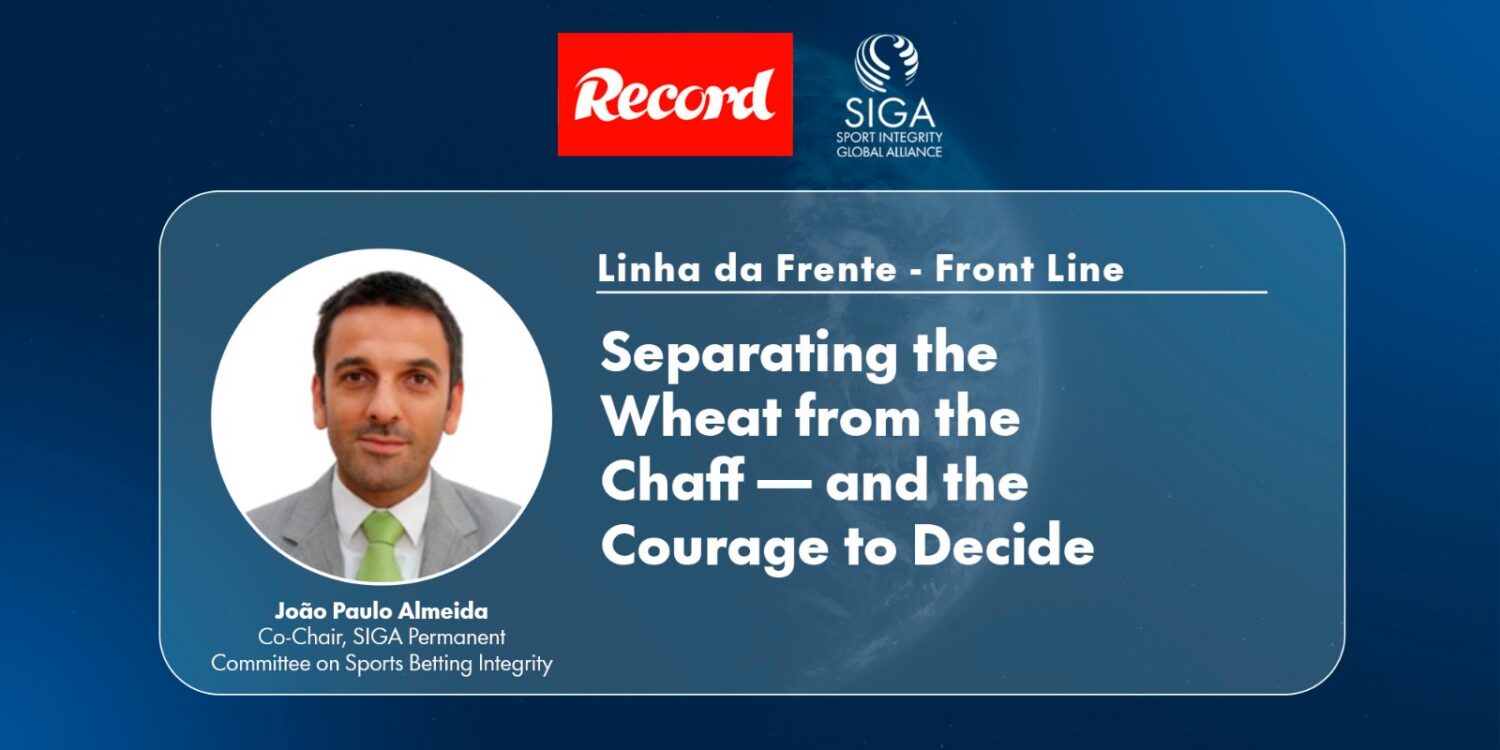
Launched on 4 June 2026 in Record, Portugal’s leading sports newspaper, SIGA’s weekly opinion column Linha da Frente (Front Line, in Portuguese) provides a dedicated platform to address issues at the heart of SIGA’s global agenda, including Sport Integrity, good governance, transparency, accountability, financial integrity, sports betting integrity, sustainability, youth development and protection, and the future of sport.
Click to read this week’s article in Portuguese.
Separating the Wheat from the Chaff — and the Courage to Decide
João Paulo Almeida, Co-Chair, SIGA Permanent Committee on Sports Betting Integrity
No sooner does a major competition end than the judgement begins. One national team played “with class”, another was “dishonest”. Moral verdicts multiply in the stands and across the headlines, as though the legitimacy of victory could be determined in the heat of public outrage. It cannot. Sporting legitimacy is earned on the field of play and can only be called into question through evidence and due process.
This is no minor detail. It is the principle that underpins the credibility of sport. A national team becomes champion because it wins under rules that apply equally to everyone. If it has breached those rules — through doping, match-fixing or corruption — sport has mechanisms to establish the facts and impose sanctions: regulations, officiating, anti-doping authorities and sports tribunals. Sanctions must be firm, but only when based on proven facts and reasoned decisions. Never on suspicion or the pressure of public opinion.
Confusing suspicion with proof is the very mistake illustrated by the parable of the wheat and the chaff two thousand years ago. When the servants wanted to pull up the weeds immediately, they were told to wait until the harvest, lest they uproot the wheat as well. The same applies in sport. Those who pass judgement too soon risk condemning legitimate merit in the name of a certainty that does not yet exist.
Such prudence does not weaken competition; it protects it. Competition, governed by rules accepted by all, has transformed rivalry between nations into a peaceful and civilised form of contest. It is an achievement of civilisation, not an instinct to be suppressed. By competing under shared rules, we learn discipline, effort, resilience, respect for opponents and the ability to accept defeat. To defend the integrity of sport is, therefore, to defend competition itself.
Who, then, ensures over time that merit is recognised and fraud punished, without one being confused with the other? It is not commentators or the indignation of the moment. It is institutions. Jean Monnet expressed it perfectly: “Nothing is possible without men; nothing is lasting without institutions.” An athlete wins a medal; it is the institution that ensures that medal will carry the same value twenty years from now.
But institutions do not exist in their own right. They depend on the quality of those who lead them. I am not referring to those who mechanically apply established rules. I mean those who bear the responsibility of deciding, enforcing and accepting the consequences of their decisions. A leader’s integrity is not measured by speeches or press releases. It is measured when the moment comes to decide, to choose principle over convenience, and to stand by that choice when it comes at a cost.
The greatest enemy of that integrity is rarely overt corruption. It is conformism: the temptation to postpone difficult decisions so as not to upset anyone, to pursue empty consensus instead of exercising leadership. Those who act this way do not decide; they temporise. They avoid conflict when they should be upholding a principle and, in shielding themselves from discomfort, end up shielding those who ought to be held accountable. That is not prudence. It is cowardice disguised as balance.
That is why the failure of a sports leader is more serious than the mistake of an athlete. The athlete breaks the rules; the leader who refuses to decide undermines the authority of the rules themselves. The greatest threat to the integrity of sport is rarely the scandal that makes the headlines. There are investigations, proceedings and sanctions for that. The real danger lies in the silent erosion caused by deferred decisions, opportunistic compromises and leadership devoid of courage.
Separating the wheat from the chaff has never been the task of the crowd. It is the mission of institutions strong enough to respect the time required for evidence, and of leaders sufficiently principled to have the courage, when the harvest comes, to reap accordingly — even when that means deciding against their own peers.
– THE END –
Previous Front Line articles
- Front Line Op-Ed: Sport Integrity – The Value of Trust (4 June 2026, Emanuel Macedo de Medeiros)
-
Front Line Op-Ed: Trust: Football’s Silent Capital (11 June 2026, Emanuel Macedo de Medeiros)
-
Front Line Op-Ed: The Trust Test (18 June 2026, Emanuel Macedo de Medeiros)
-
Front Line Op-Ed: Digital Success, IP Protection and Sports Integrity (9 July 2026, Martin Bland)
ABOUT SIGA
SIGA is the world’s leading organisation for Sport Integrity. We are creating a whole new landscape for the sports industry by delivering independent global rating and certification for world Sport to ensure it is governed and operates under the highest integrity standards: The SIGA Universal Standards.
Funded by our Members, SIGA is a non for profit global independent organisation with one aim: To ensure the sport industry is governed under the highest integrity standards so that the values of sport are protected.
SIGA is the only organisation to bring together sport, governments, academia, international organisations, sponsors, business, rights holders, NGOs and professional services companies, from every region in the world, around a common cause of fostering greater integrity throughout sport.
SIGA is headquartered in Geneva, Switzerland, as a non for-profit association, and comprises of the following continental subsidiaries: SIGA AMERICA, SIGA EUROPE and SIGA LATIN AMERICA.
For more information on SIGA, including its vision, mission and reform agenda, please refer to the website: www.siga-sport.com and FAQs.
To contact SIGA, please email: comms@siga-sport.com.