
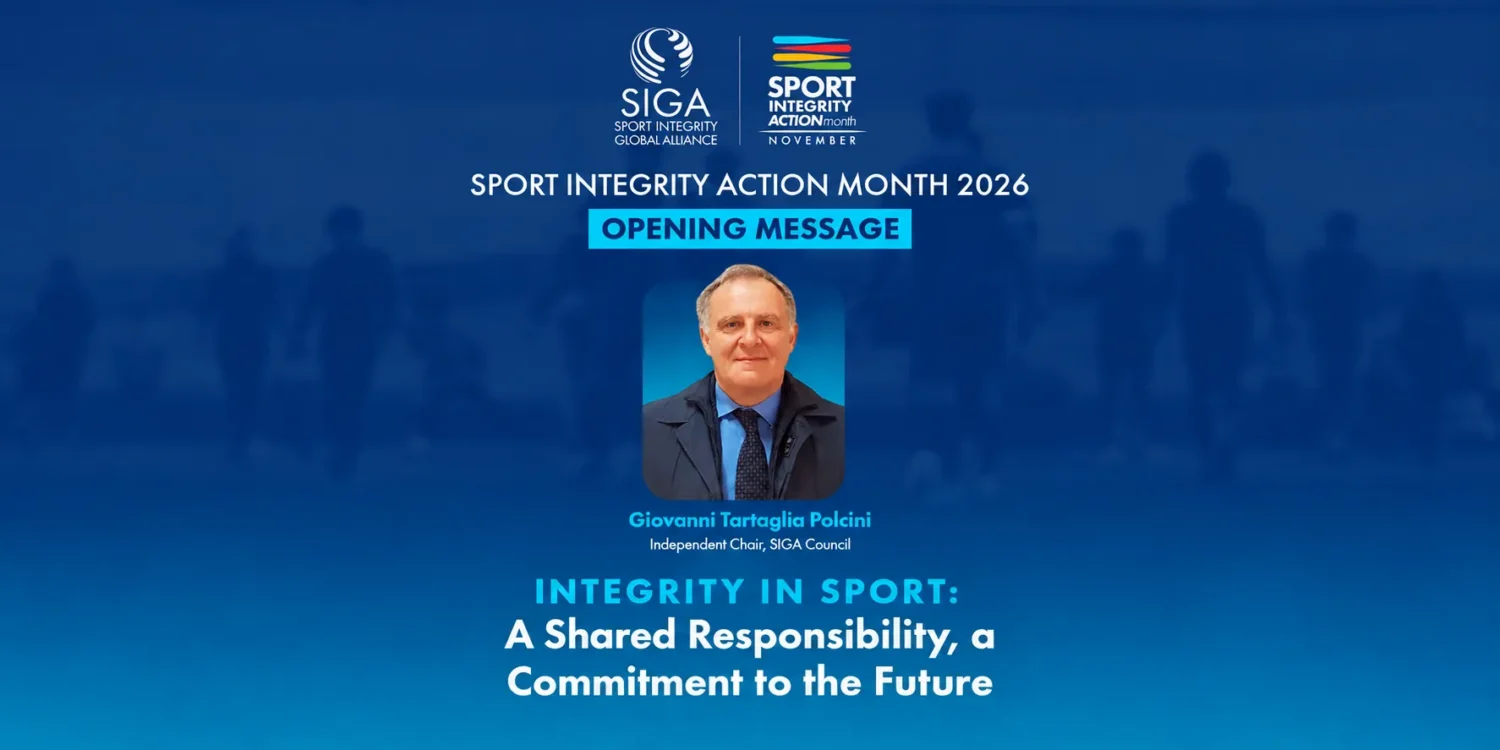
 By Giovanni Tartaglia Polcini
Chair, Sport Integrity Global Alliance (SIGA)
Sport has an extraordinary ability to bring people together, transcend boundaries and convey values that form part of humanity’s shared heritage. Through its disciplines, competitions and key figures, it promotes respect, discipline, solidarity and the recognition of merit. Its influence, however, entails a responsibility commensurate with its social significance: that of preserving the trust of millions of athletes, supporters and citizens.
It is in this context that integrity takes on fundamental significance. It is not a secondary aspect of sporting activity, nor is it a principle to be invoked solely in the wake of scandals or breaches. On the contrary, it is the very condition that makes sport credible, legitimate and true to its educational and social purpose.
Without integrity, the result loses some of its value, competition loses its meaning, and public trust risks turning into disillusionment. Protecting integrity therefore means protecting sport itself.
From principles to behaviour: the value of setting an example
Integrity is manifested first and foremost in the concrete choices made by those who practise, administer and represent sport. It is measured by the ability to abide by the rules even when no one is watching, to acknowledge an opponent’s merit, to accept one’s responsibilities and to prioritise the values of competition over immediate personal gain.
Sporting history offers significant examples of this culture.
In 1964, at the Tokyo Olympics, the Ethiopian marathon runner Abebe Bikila won his second consecutive Olympic gold medal, four years after his triumph in Rome. His achievement remains a symbol of discipline, determination and dedication: qualities that remind us how sporting excellence is the result of rigorous commitment and a deep understanding of one’s role.
Other incidents illustrate the meaning of loyalty even more directly. At the 2016 Rio de Janeiro Olympics, the middle-distance runners Abbey D’Agostino of the United States and Nikki Hamblin of New Zealand fell during a 5,000-metre heat. Rather than focusing solely on their own performance, they helped each other to get back on their feet and continue the race. Their gesture reminded the world that solidarity is not at odds with competitive ambition: rather, it represents one of its highest expressions.
These examples, which vary in context and discipline, share one essential element: integrity becomes credible when it translates into recognisable behaviour. Champions can make a decisive contribution to this culture, as their influence reaches, above all, the younger generations, for whom the manner in which one wins or loses is often just as important as the result itself.
Responsibility, however, cannot be delegated solely to athletes. Officials, coaches, referees, federations, leagues, sponsors, agents and media professionals all play a part, each according to their role, in determining the ethical quality of the sporting ecosystem. Integrity must be a shared responsibility, underpinned by clear rules, independent oversight, transparency in decision-making and effective consequences in the event of a breach.
A challenge affecting the entire sporting system
Today, the threats to integrity are manifold and interlinked. Corruption, conflicts of interest, financial opacity, match-fixing, the risks associated with sports betting and shortcomings in athlete protection systems can undermine not only individual events, but also the credibility of institutions and the sustainability of the entire sporting movement.
Added to these challenges are the responsibilities arising from the growing commercial dimension of sport and technological developments. Innovation can generate extraordinary opportunities, but it requires appropriate safeguards to ensure that new tools, platforms and business models do not become vehicles for a lack of transparency, exploitation or misconduct.
A particularly topical issue is the debate in Brazil regarding restrictions on the activities of betting companies and their commercial presence in sport, including sponsorship on football clubs’ shirts. Recent measures adopted in the country have reignited a complex debate, in which the need to protect citizens, the responsibility of operators, the economic sustainability of sports clubs and the protection of sporting values are all weighed up.
This is not an issue that can be addressed solely in terms of commercial revenue or advertising opportunities. The presence of betting-related brands in a highly visible space, such as a team’s shirt, raises questions about the responsibility of those who benefit from the popularity of sport and about their influence – whether direct or indirect – particularly on young people.
At the same time, the economic consequences of the restrictions require careful assessment, so that companies can identify alternative and sustainable funding models. The point is not to set integrity and economic resources against one another in a simplistic manner, but rather to recognise that financial stability and ethical responsibility must go hand in hand.
The Brazilian case therefore presents an important opportunity for international reflection. It demonstrates how essential it is to promote clear regulatory frameworks, shared responsibilities, appropriate oversight mechanisms and constructive collaboration between public authorities, sports organisations and commercial operators. The regulation of sponsorship, the prevention of conflicts of interest and the protection of vulnerable individuals must form part of a comprehensive integrity strategy capable of looking beyond immediate needs.
The principle to be upheld is simple: no commercial interest, however significant, should compromise the credibility of sport or take precedence over the protection of people and the values that sport represents.
Leadership with integrity: turning commitment into action
In this context, the leadership of sports organisations takes on crucial importance. Declaring one’s support for integrity is necessary, but not sufficient. Principles must be translated into procedures, commitments into verifiable results, and declarations into an everyday organisational culture.
This requires effective policies to prevent and combat corruption, reliable reporting systems, transparency in the management of resources, independent oversight and adequate training for those working in the sector. It also requires organisations to be willing to undergo credible audits and to be accountable for their decisions.
This is the context in which the mission of the Sport Integrity Global Alliance (SIGA) is situated; the Alliance is committed to promoting universal standards of integrity, good governance, transparency and accountability in sport. SIGA’s work is based on the conviction that lasting change cannot depend solely on the awareness of individuals, but must be underpinned by robust, shared and verifiable systems.
Sport Integrity Action Month 2026 offers a concrete opportunity to renew this commitment. Its effectiveness will not be measured solely by the number of initiatives carried out or organisations involved, but by its ability to raise awareness, consolidate good practices and bring about tangible changes in the way sport is governed and experienced.
I therefore call upon federations, leagues, clubs, athletes, sponsors, public institutions, the media and professionals to play an active part in this process. Every organisation can make a difference: through a responsible decision, a more transparent procedure, a commercial choice consistent with its stated values, or by setting an example capable of inspiring the younger generations.
The future of sport will not depend solely on the quality of performances, the spectacle of competitions or the ability to attract investment. Above all, it will depend on the trust we are able to earn.
“Integrity is not a goal that is achieved once and for all. It is an ongoing commitment that must guide every decision and every action.”
As an international sporting community, we have a responsibility to demonstrate that excellence and fairness, ambition and respect, success and responsibility are not mutually exclusive objectives, but inseparable aspects of the same endeavour.
If sport is to continue to be a positive force for society, we must ensure that winning matters, but that the way in which one wins also matters; that success is celebrated, but that it is always deserved; and that sporting organisations are recognised not only for what they achieve, but also for the principles they choose to uphold.
“Integrity is the foundation of trust. And trust is the most precious asset that sport can pass on to present and future generations.”
– THE END –
ABOUT SIGA
SIGA is the world’s leading organisation for Sport Integrity. We are creating a whole new landscape for the sports industry by delivering independent global rating and certification for world Sport to ensure it is governed and operates under the highest integrity standards: The SIGA Universal Standards.
Funded by our Members, SIGA is a non for profit global independent organisation with one aim: To ensure the sport industry is governed under the highest integrity standards so that the values of sport are protected.
SIGA is the only organisation to bring together sport, governments, academia, international organisations, sponsors, business, rights holders, NGOs and professional services companies, from every region in the world, around a common cause of fostering greater integrity throughout sport.
SIGA is headquartered in Geneva, Switzerland, as a non for-profit association, and comprises of the following continental subsidiaries: SIGA AMERICA, SIGA ASIA, SIGA EUROPE and SIGA LATIN AMERICA.
For more information on SIGA, including its vision, mission and reform agenda, please refer to the website: www.siga-sport.com and FAQs.
To contact SIGA, please email: comms@siga-sport.com.