
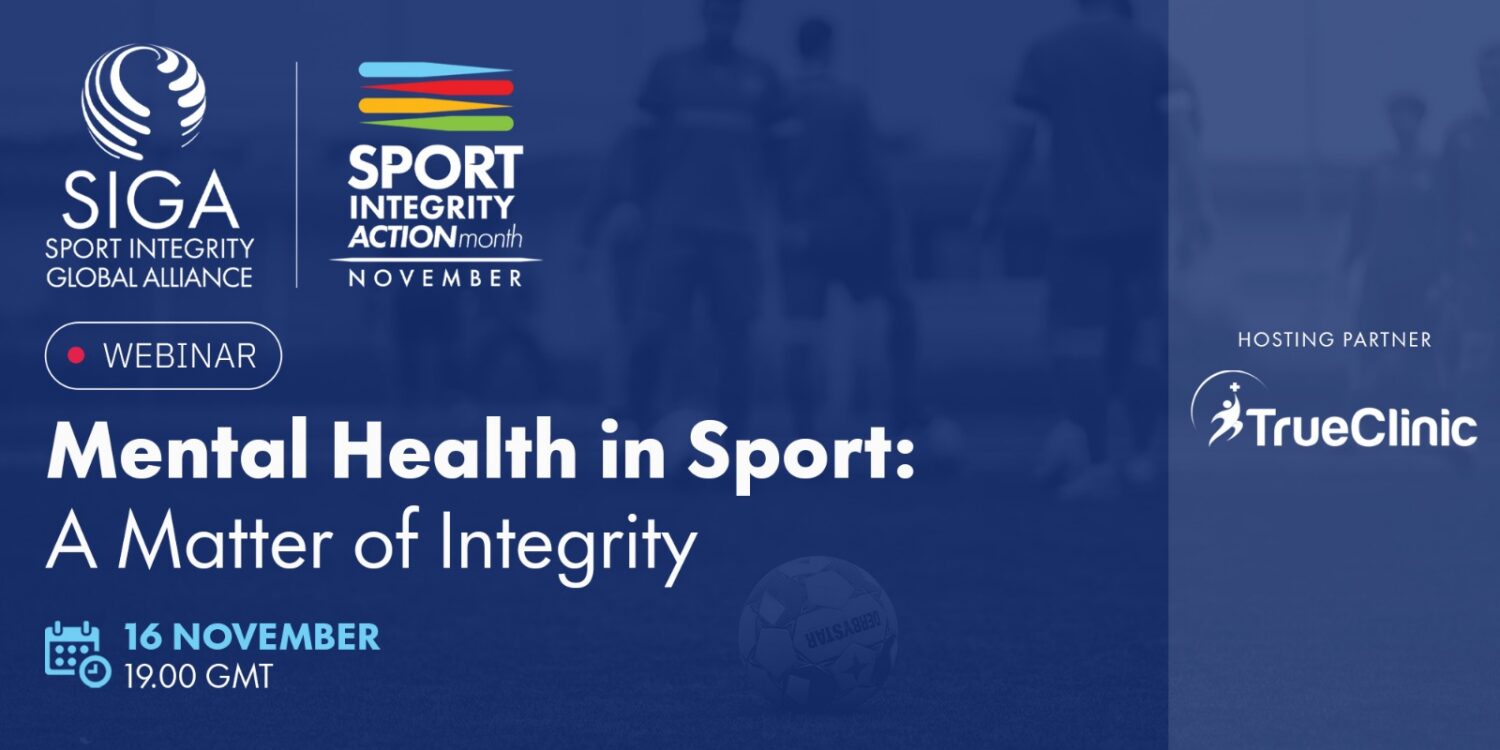
Held as part of Sport Integrity Action Month, the webinar examined the pressures facing athletes, the importance of mental health support, the impact of injuries and the challenges of transitioning beyond competitive sport.
Mental health is not separate from sporting performance. It is a fundamental component of athlete wellbeing, responsible leadership and Sport Integrity.
This was the central message of “Mental Health in Sport: A Matter of Integrity”, a webinar hosted by Trueclinic, a SIGA Member, as part of Sport Integrity Action Month 2026.
Bringing together perspectives from elite Sport, coaching and healthcare, the discussion reinforced the need to place mental health at the heart of sporting environments and to ensure that athletes receive the support, protection and understanding they need throughout their careers and beyond.
The webinar featured Miguel Gouveia de Brito, CEO of Trueclinic and Co-Chair of the SIGA Council; Carlos Fernandes, Sport and Performance Psycologist; Ricardo Peres, football coach; and Susana Feitor, former Olympian and President of the Foundation of Sport.
A sporting environment cannot be considered healthy solely because it delivers results. It must also provide the conditions for athletes, coaches and support staff to develop, perform and fulfil their potential without compromising their physical or mental wellbeing.
Ricardo Peres emphasised the importance of building teams around a shared purpose, clearly defined objectives and mutual understanding. Such foundations, he argued, are essential to creating environments in which individuals can work collectively while maintaining their sense of belonging and personal responsibility.
The discussion also explored the distinction between recreational participation and elite competition. While Sport can provide social connection, personal development and a sense of community, high-performance environments introduce additional pressures, including the relentless pursuit of results and the expectation to perform under intense scrutiny.
These demands extend beyond athletes. Coaches and technical staff also face significant psychological pressure, particularly when they carry responsibility for the performance and development of others.
Rather than seeking to eliminate pressure, Peres advocated greater self-awareness and the development of strategies to manage it constructively. Understanding personal reactions, he suggested, is an essential leadership skill and a prerequisite for supporting others effectively.
Breaking Down Barriers to Mental Health Support
One of the webinar’s central conclusions was that seeking psychological support must be recognised as a sign of responsibility and self-awareness, rather than weakness.
Drawing on her experience as an elite athlete, Susana Feitor reflected on the anxiety, fear of failure and weight of expectations that can accompany high-level competition.
Her contribution highlighted the importance of creating spaces where athletes feel able to acknowledge difficulties, reflect on setbacks and seek guidance without fear of judgement or negative consequences.
Although mental health has gained greater visibility in Sport, the panel acknowledged that entrenched attitudes and cultural barriers continue to discourage open conversations.
Changing this reality requires more than raising awareness. It demands a sustained commitment from sporting organisations to establish environments in which psychological support is accessible, trusted and integrated into everyday practice.
Coaches, healthcare professionals, psychologists, nutritionists, families and other members of an athlete’s support network all have a role to play.
The message was clear: athletes should never have to face the pressures of competitive Sport alone, nor should they need to reach a point of crisis before receiving appropriate support.
Injury, Recovery and the Need for Integrated Care
The webinar also addressed the psychological consequences of injury, challenging approaches to rehabilitation that focus exclusively on physical recovery.
Injuries can affect an athlete’s confidence, emotional stability, professional identity and sense of purpose. The pressure to return to competition can further complicate an already demanding recovery process.
Susana Feitor highlighted the importance of coordination between athletes, coaches and medical professionals, drawing on her own experience of rehabilitation.
She explained how closer collaboration between her coach and clinical team contributed to a clearer recovery plan, improved communication and a more structured return to training.
Miguel Gouveia de Brito underlined that, despite growing awareness of mental health challenges in Sport, psychological support has not yet achieved the same level of integration as physical healthcare.
He also drew attention to the expectations placed on injured athletes to return to competition as quickly as possible.
The discussion reinforced the importance of a multidisciplinary approach in which physical rehabilitation, psychological wellbeing, communication and injury prevention are treated as interconnected responsibilities.
Beyond Competition: Preparing for Life After Sport
Another key focus was the transition from competitive Sport to life after retirement.
For athletes whose identities, routines and ambitions have been closely associated with sporting achievement, the end of a career can represent a profound personal and psychological challenge.
Whether retirement is planned or brought forward by injury or other circumstances, the transition can affect not only athletes but also their families and wider support networks.
The panel stressed that preparing for life beyond competition must begin long before an athlete’s final sporting appearance.
Supporting athletes through education, personal development, career planning and psychological preparation is essential to ensuring that sporting success does not come at the expense of long-term wellbeing.
This responsibility must be shared by athletes, coaches, sporting organisations and the professionals who accompany them throughout their careers.
Athlete Wellbeing Is a Sport Integrity Responsibility
The webinar reinforced a fundamental principle: safeguarding the integrity of Sport also means safeguarding the people who make Sport possible.
Mental health cannot be treated as an isolated clinical concern or as an issue to be addressed only when difficulties arise. It must be recognised as an integral dimension of athlete welfare, institutional responsibility and good governance.
For sporting organisations, this means moving beyond statements of principle and translating commitments into concrete policies, appropriate support structures and organisational cultures that prioritise prevention, protection and accountability.
These objectives are consistent with SIGA’s Universal Standards on Sport Integrity, particularly its commitment to Good Governance and Youth Development and Protection, and with its broader mission to promote responsible, transparent and accountable sporting institutions.
By bringing together expertise from healthcare, coaching and elite competition, Trueclinic’s webinar contributed to the objectives of Sport Integrity Action Month: promoting informed debate, encouraging collaboration and advancing meaningful action across the global sporting ecosystem.
The overarching message was unequivocal: Sport Integrity is not measured by results alone. It is also reflected in how sporting organisations treat, protect and support athletes — during competition, through adversity and long after their sporting careers have ended.
– THE END –
ABOUT SIGA
SIGA is the world’s leading organisation for Sport Integrity. We are creating a whole new landscape for the sports industry by delivering independent global rating and certification for world Sport to ensure it is governed and operates under the highest integrity standards: The SIGA Universal Standards.
Funded by our Members, SIGA is a non for profit global independent organisation with one aim: To ensure the sport industry is governed under the highest integrity standards so that the values of sport are protected.
SIGA is the only organisation to bring together sport, governments, academia, international organisations, sponsors, business, rights holders, NGOs and professional services companies, from every region in the world, around a common cause of fostering greater integrity throughout sport.
SIGA is headquartered in Geneva, Switzerland, as a non for-profit association, and comprises of the following continental subsidiaries: SIGA AMERICA, SIGA ASIA, SIGA EUROPE and SIGA LATIN AMERICA.
For more information on SIGA, including its vision, mission and reform agenda, please refer to the website: www.siga-sport.com and FAQs.
To contact SIGA, please email: comms@siga-sport.com.