

Development money belongs to football. Every association must remain free to question its leaders and cast its vote.
By Emanuel Macedo de Medeiros
Co-Founder & Global CEO, SIGA
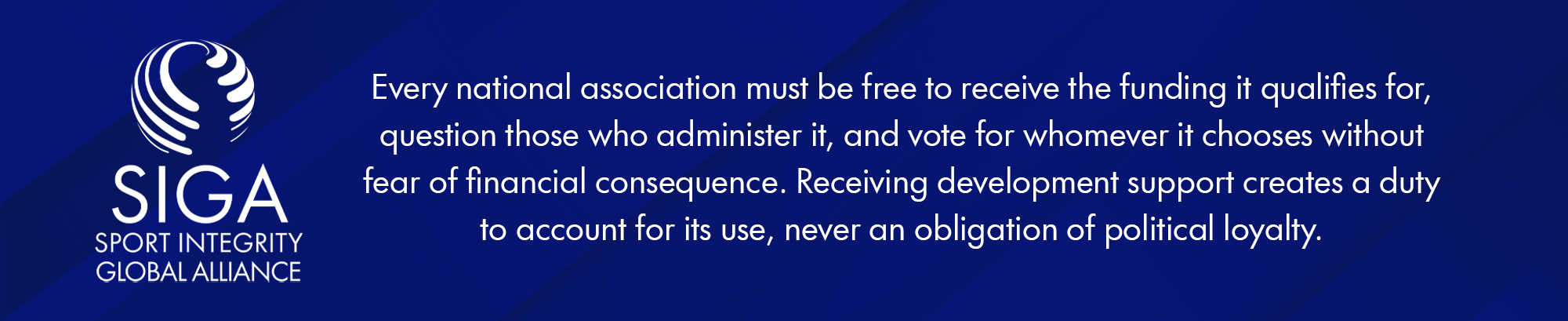
Every national association must be free to receive the funding it qualifies for, question those who administer it, and vote for whomever it chooses without fear of financial consequence.
FIFA’s money belongs to the institution. The President and other officeholders are entrusted with ensuring that it serves the purposes set out in FIFA’s Statutes. Distributing it creates no entitlement to personal or political loyalty.
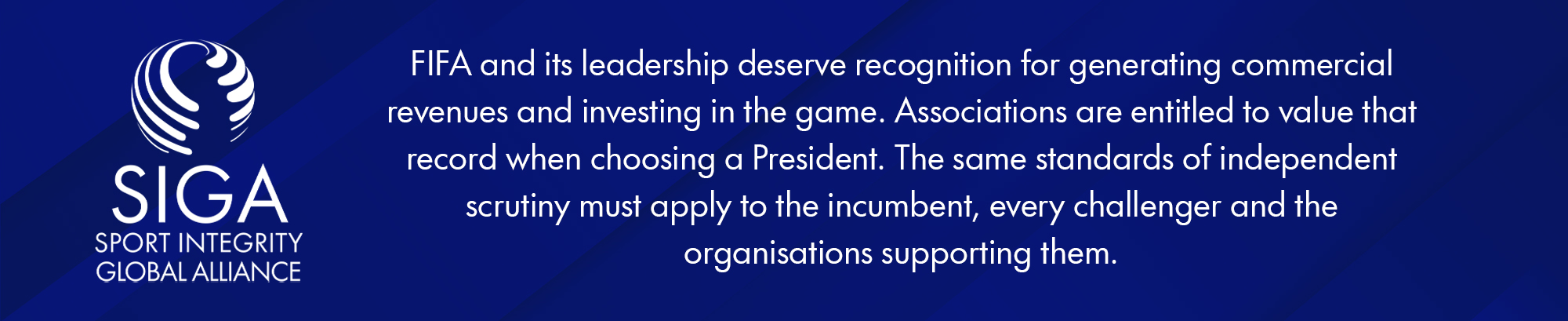
FIFA and its leadership deserve recognition for generating commercial revenues and investing more of football’s wealth in the game. Associations are entitled to value that record when choosing a President. What matters is that they make their choice freely, without feeling that access to institutional resources depends on supporting a particular person.
CAF, CONMEBOL and the Union of Arab Football Associations have recently reaffirmed their support for Gianni Infantino. Those endorsements are legitimate political choices. The same freedom belongs to every association, whichever candidate it supports.
For an association with limited resources, solidarity funding can keep a women’s league running, pay for coaches or allow a national team to travel. Those needs are real. They make reliable funding essential, and they make the association’s freedom of choice worth protecting.
On 15 October, FIFA announced a proposed US$6.35 billion development package for 2027–2030. It has since described each of its 211 member associations as eligible for up to US$25 million. The associations eligible for this funding also elect FIFA’s President.
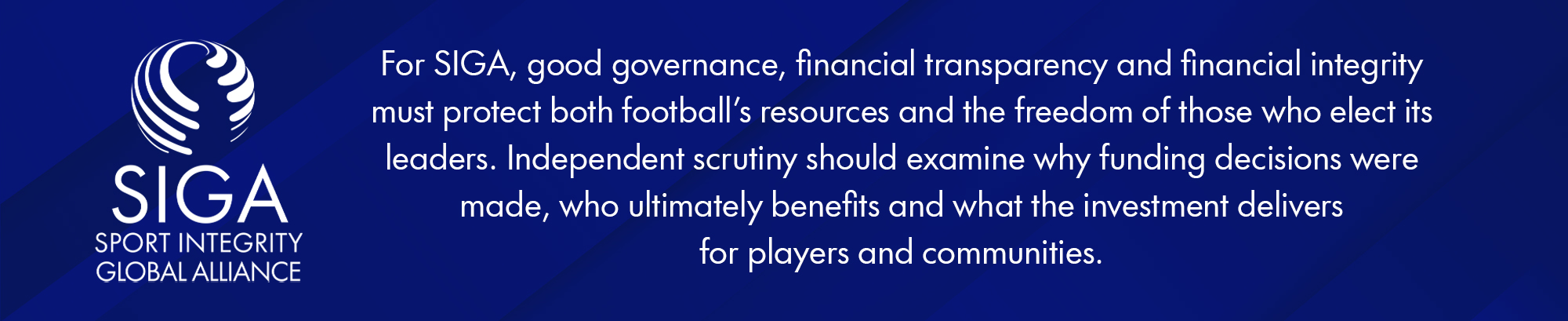
Development funding can carry considerable weight in an association’s assessment of a President’s record and its expectations of future leadership. Good governance, financial transparency and financial integrity must therefore protect both the proper use of football’s resources and the freedom of those who elect its leaders.
FIFA has said the detailed eligibility, approval, payment and audit arrangements will be finalised in December, before the programme goes to Congress for approval in March. Reuters has since reported a January 2027 start. The approval sequence and payment timetable should therefore be made clear. The associations should be able to examine the safeguards alongside the financial commitments.
WHAT THE RECORD SHOWS
In Trinidad and Tobago, Concacaf’s 2013 Integrity Committee reported that the land beneath its Centre of Excellence was held by companies owned by Jack Warner. FIFA financing had helped develop the facility. A project intended to serve the region’s football had exposed a fundamental failure to protect institutional ownership.
In May 2024, FIFA’s Ethics Committee sanctioned five former or serving Bangladesh Football Federation officials over transactions supported by false or falsified documentation, paid or expected to be paid with FIFA funds. FIFA deserves credit for taking action. The case also shows why scrutiny has to test the documents used to justify expenditure, rather than simply accept them.
The two cases involved different conduct, but both point to questions that should be settled before money is committed: who owns the asset, who benefits from the contract, and can the supporting records be relied on? Every dollar lost to abuse is a dollar unavailable to the players and communities the programme exists to serve.
 WHO ACTUALLY DECIDES?
Forward already has rules addressing how development money is allocated and used. Its regulations require FIFA to manage the programme impartially and transparently. Forward 3.0 provides up to US$8 million per association for 2023–2026, with additional travel and equipment assistance for eligible associations. Funding is linked to agreed objectives and specified activities.
For applications seeking less than US$300,000 in specific project funding, FIFA’s general secretariat decides. At US$300,000 or more, the Development Committee decides. The regulations set decision deadlines and require reasons for rejecting an application.
The framework also requires dedicated bank accounts, procurement procedures, independent statutory audits and annual central audit reviews. FIFA publishes payment information. Those are substantial protections; independent scrutiny should establish how well they work in practice.
Examining expenditure alone cannot establish whether equally eligible associations received fair treatment. That requires access to the decisions made before payment: why an application was approved, why another was delayed or rejected, and who authorised an exception.
FUNDING AND FREEDOM OF CHOICE
An association should know what funding it qualifies for, when it will be paid and what could justify withholding it. An association’s choice of candidate must neither improve nor diminish its entitlement to development funding. Criticising a policy must have no bearing on its treatment. Where there is a real compliance failure, FIFA must be able to act, and the association must have access to a prompt, independent review.
Keeping institutional resources separate from campaigning requires particular care during an election. Exceptional grants and accelerated payments should have a published justification and independent oversight. Normal support should continue throughout the campaign, with decisions taken under the programme’s rules and communicated as decisions of the institution.
Independent oversight depends on who is appointed and whether they can do their work without interference. Major grant committees should include members who meet published independence criteria. Reviewers need secure terms of appointment, access to the full decision files and the freedom to publish their findings. Declared interests, recusals and the reasons for significant decisions should be public.
The examination should follow the money through confederations, associations, contractors and other intermediaries. It should identify the people who ultimately own a supplier, any financial interest an official or relative holds, and the legal owner of a completed asset. These checks belong at the approval stage and throughout delivery.
A training centre’s value depends on whether people can use it and whether there is money to maintain it. A grant for women’s football should produce opportunities that women and girls can access. Publishing significant audit findings, the action taken and evidence that problems were resolved would allow communities to judge what the investment has achieved.
These protections give associations greater certainty and FIFA stronger evidence that its investment serves the game.
THE SAME STANDARD, WHOEVER WINS
These principles should govern FIFA’s funding decisions and those of every confederation and national association, whoever they support. Transferring responsibility to another level of football leaves the need for scrutiny intact.
All those seeking FIFA’s Presidency should commit to these protections. Organisations endorsing a candidate or calling for reform should accept independent examination of their own decisions, including findings they may find uncomfortable.
This is the position SIGA will uphold, whoever leads FIFA: development funding must be transparent in its allocation, accountable in its use and independently scrutinised. The SIGA Universal Standards on Good Governance and Financial Integrity set out the requirements, while the SIGA Independent Rating and Verification System (SIRVS) assesses compliance.
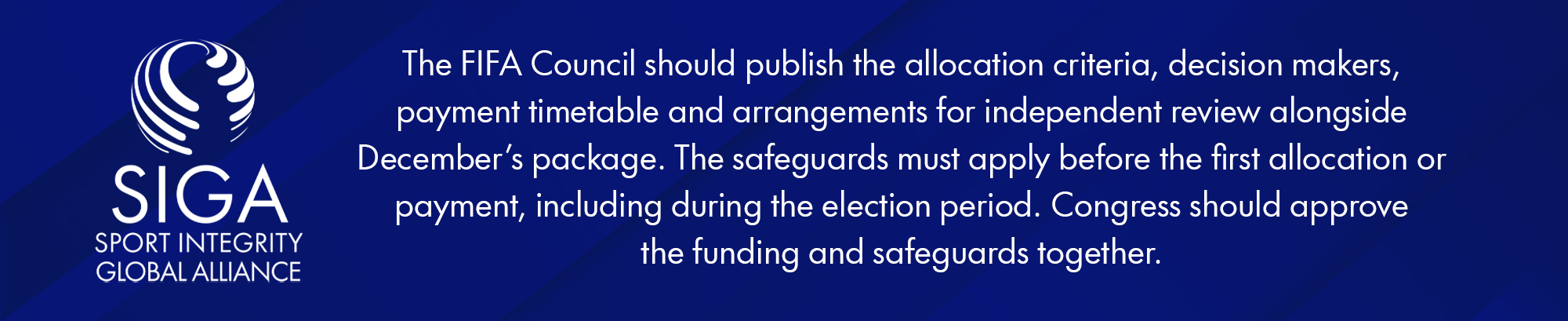
When it finalises the package in December, the FIFA Council should publish the allocation criteria, the decision makers, the payment timetable and the arrangements for independent review. These safeguards must be in place before the first allocation or payment and apply throughout the programme. Congress should approve the resources and those safeguards together.
The strongest legacy a President can leave is an institution whose members can disagree with its leadership without fearing for their future.
Development funding must strengthen football’s independence. That includes independence from those who distribute it.
– THE END –
ABOUT SIGA
SIGA is the world’s leading organisation for Sport Integrity. We are creating a whole new landscape for the sports industry by delivering independent global rating and certification for world Sport to ensure it is governed and operates under the highest integrity standards: The SIGA Universal Standards.
Funded by our Members, SIGA is a non for profit global independent organisation with one aim: To ensure the sport industry is governed under the highest integrity standards so that the values of sport are protected.
SIGA is the only organisation to bring together sport, governments, academia, international organisations, sponsors, business, rights holders, NGOs and professional services companies, from every region in the world, around a common cause of fostering greater integrity throughout sport.
SIGA is headquartered in Geneva, Switzerland, as a non for-profit association, and comprises of the following continental subsidiaries: SIGA AMERICA, SIGA ASIA, SIGA EUROPE and SIGA LATIN AMERICA.
For more information on SIGA, including its vision, mission and reform agenda, please refer to the website: www.siga-sport.com and FAQs.
To contact SIGA, please email: comms@siga-sport.com.
@Sigalliance – Twitter, Instagram, Linkedin | #SIGA #SIGAWoW