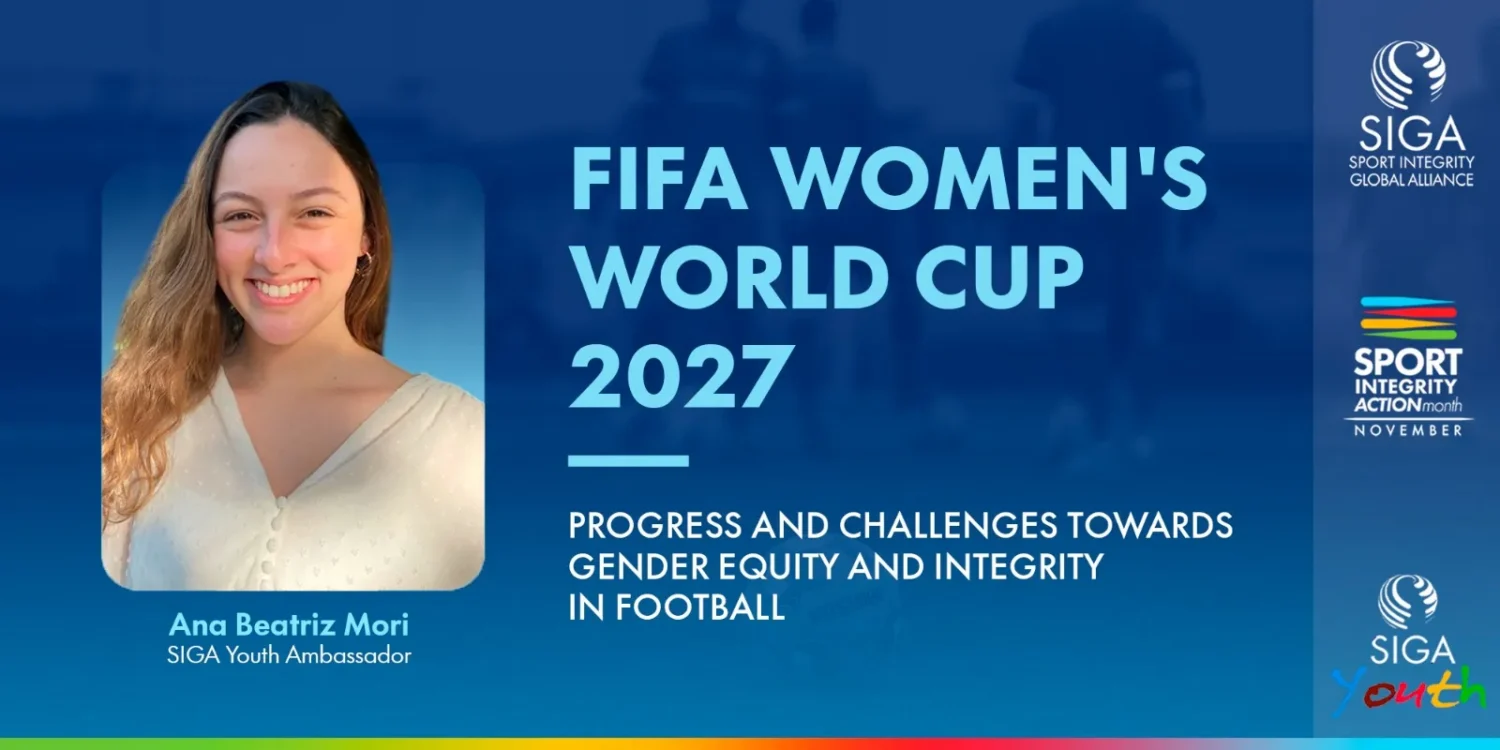
By Ana Beatriz Mori
SIGA Youth Ambassador
With less than a year to go before the 2027 FIFA Women’s World Cup, the international sporting community is turning its attention to Brazil, the first South American country to host the competition. Expectations are high that the tournament will become the biggest edition in its history in terms of global reach, ticket sales, attendance, revenues and investment. However, great ambitions must also come with great responsibilities, including a continued commitment to sports integrity and to creating a lasting legacy for women and girls in football.
On October 22, 2026, the FIFA Council announced the approval of a new financial distribution model for the tournament. Each participating team will receive US$ 2.5 million in preparation funding, matching the amount allocated to teams competing in the 2026 FIFA Men’s World Cup. The model also provides for equivalent service standards for female players, as well as increased payments to clubs and associations. In parallel, FIFA plans to raise the minimum guaranteed payment to each participating player from US$ 30.000 to US$ 60.000. Despite representing significant progress, these measures do not amount to equal prize money across individual and collective awards.
For the 2027 edition, FIFA plans to allocate at least US$ 220 million in prize money, more than double the US$ 110 million distributed at the 2023 tournament, hosted by Australia and New Zealand. Nevertheless, the proposed amount would remain below the level considered proportionate to the men’s tournament, which allocated US$ 655 million in performance-based prize money in 2026. This gap highlights the distance between the progress being announced and FIFA’s public commitment, made during its 73rd Congress in 2023, to achieve equal payments for female players at the 2027 Women’s World Cup.
Without gender equity, there can be no integrity in sport. Without pay equity, there can be no fair play. In this context, international mobilization by athletes, institutions, authorities and civil society is essential to building a genuinely inclusive and equitable sporting ecosystem. Following a letter submitted by FIFPRO — the international union representing professional footballers worldwide — and representatives from 45 countries, calling for proportional prize money and minimum standards for women’s national teams, players have begun considering legal action should no progress be made.
Brazil also faces significant challenges. In a country where women were legally prohibited from playing football for nearly forty years, the enactment of Law No. 15.522/2026 on September 28, 2026, represents a milestone. The legislation establishes guidelines for the development of women’s football nationwide, making it a priority within public sports policy. It also promotes greater opportunities through a focus on equal opportunities, incentives for equal pay, pregnancy and maternity protection, the prevention of discrimination and violence, and increased female representation in management, technical leadership and refereeing positions.
The Law also amends provisions of the Football Corporation Law (Law No. 14.193/2021) and the General Sports Law, including the mandatory maintenance of women’s teams as one of the requirements for the certification of youth development clubs, as well as the adoption of protocols to prevent discrimination and violence. This change becomes even more relevant when considering the disparity between approximately 690 professional men’s clubs and around 194 women’s teams registered with football federations. Furthermore, the Law reinforces the provision for a social, sporting and financial legacy plan for the 2027 FIFA Women’s World Cup.
Complementing these developments, Law No. 15.421/2026, enacted in June, granted a R$ 500.000 award to each player who represented Brazil in the 1988 tournament and the 1991 FIFA Women’s World Cup. This measure recognizes the pioneers who represented the national team at a time of restrictions and limited resources, providing historical reparations and acknowledging the journeys that paved the way for today’s generations.
The 2027 World Cup offers Brazil and the international community an opportunity to turn commitments into lasting practices, supported by clear responsibilities and monitoring mechanisms. The tournament will be more than a showcase for women’s football. It will also reflect the choices that shape the sporting landscape. Its historical significance, however, will depend above all on what remains once the stadiums have emptied. It is through this continuity, built on cooperation between institutions, athletes and society, that gender equity can move beyond being a topic of discussion and become an integral part of the very definition of sports integrity.
– THE END –
ABOUT SIGA
SIGA is the world’s leading organisation for Sport Integrity. We are creating a whole new landscape for the sports industry by delivering independent global rating and certification for world Sport to ensure it is governed and operates under the highest integrity standards: The SIGA Universal Standards.
Funded by our Members, SIGA is a non for profit global independent organisation with one aim: To ensure the sport industry is governed under the highest integrity standards so that the values of sport are protected.
SIGA is the only organisation to bring together sport, governments, academia, international organisations, sponsors, business, rights holders, NGOs and professional services companies, from every region in the world, around a common cause of fostering greater integrity throughout sport.
SIGA is headquartered in Geneva, Switzerland, as a non for-profit association, and comprises of the following continental subsidiaries: SIGA AMERICA, SIGA ASIA, SIGA EUROPE and SIGA LATIN AMERICA.
For more information on SIGA, including its vision, mission and reform agenda, please refer to the website: www.siga-sport.com and FAQs.
To contact SIGA, please email: comms@siga-sport.com.