
The NFL and NCAA are right to demand tougher rules for sports prediction markets.
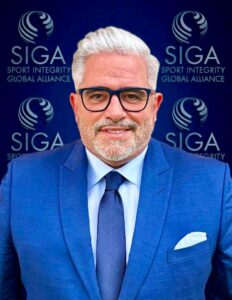
By Emanuel Macedo de Medeiros
Co-Founder & Global CEO, SIGA
Chairman & CEO, SIGA AMERICA
“Greed, for lack of a better word, is good,” Gordon Gekko told shareholders in Wall Street. Good for whom? Ask the student-athlete blamed for a stranger’s gambling loss. In October, the US exchange ProphetX self-certified a class of contracts tied to individual player statistics in Division I women’s basketball. One filing asked whether a Notre Dame player would score more than 24.5 points against Villanova. A student’s box score had become a financial product.
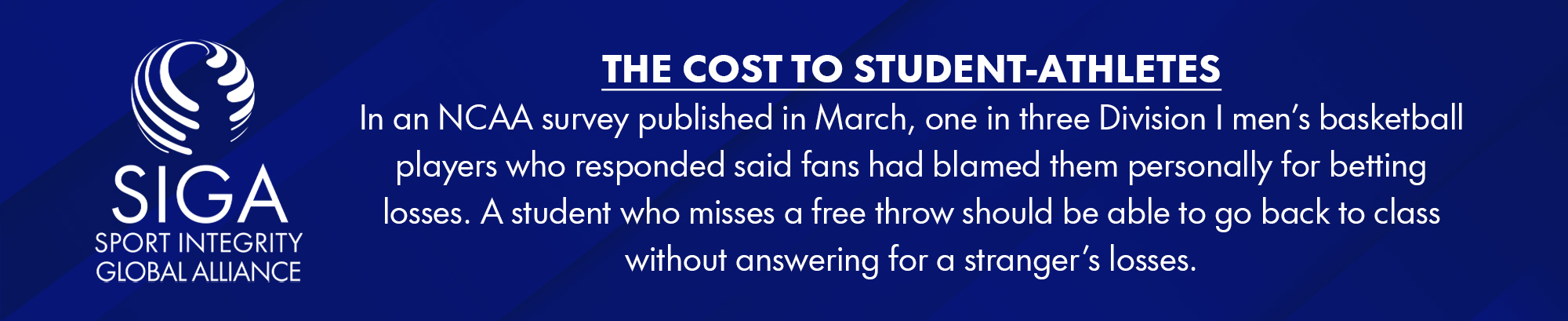
In January, NCAA President Charlie Baker asked the Commodity Futures Trading Commission (CFTC) to suspend college Sport prediction markets until safeguards were in place. He followed with a call to ban contracts tied to individual college athletes’ performances. In an NCAA survey published in March, one in three Division I men’s basketball players who responded said fans had blamed them personally for betting losses. A student who misses a free throw should be able to go back to class without answering for a stranger’s losses.
THE SAME GAME. THE SAME PROTECTION.
On a prediction market, people buy and sell contracts that pay out according to what happens. Buy a contract that pays if a team wins or back the same team through a sportsbook. Your money rides on the same result. Kalshi allows people to open an account at 18. In the United States, you must be 21 to buy a beer or, in most states with legal sports betting, to place a wager. The NFL wants that minimum age for sports event contracts, and the NCAA has called for it in college Sport. The same game deserves the same protection. Call it a bet, a contract or a financial product. Changing the name does not change the risks to Sport integrity.
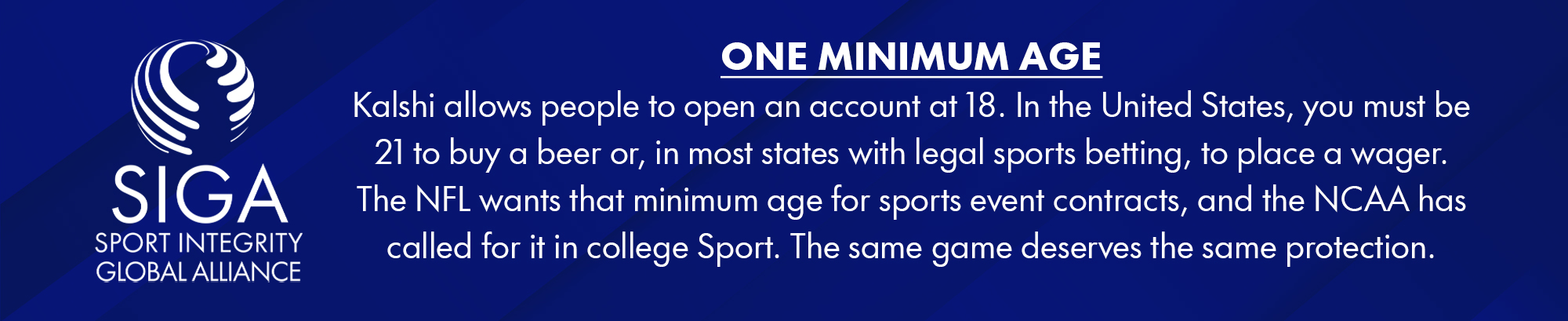
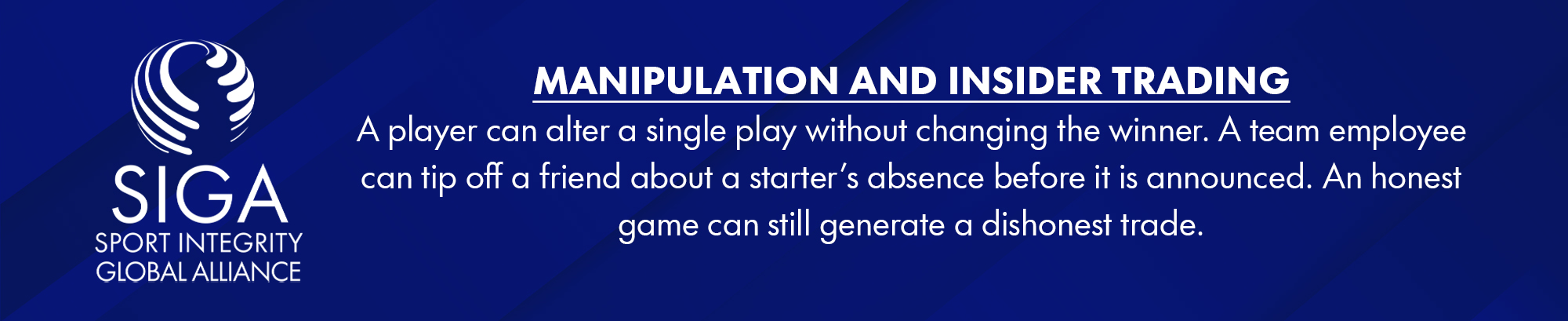
On 8 October, the NFL urged the US Supreme Court to take up New Jersey’s dispute with Kalshi over whether federal law displaces state gambling rules for sports event contracts. The league wants exchanges to bar contracts tied to injuries, officiating decisions, events one person can readily manipulate and outcomes that insiders can know in advance. A player can alter a single play without changing the winner. A team employee can tip off a friend about a starter’s absence before it is announced. An honest game can still generate a dishonest trade.
INDEPENDENT STANDARDS. ENFORCEABLE SAFEGUARDS.
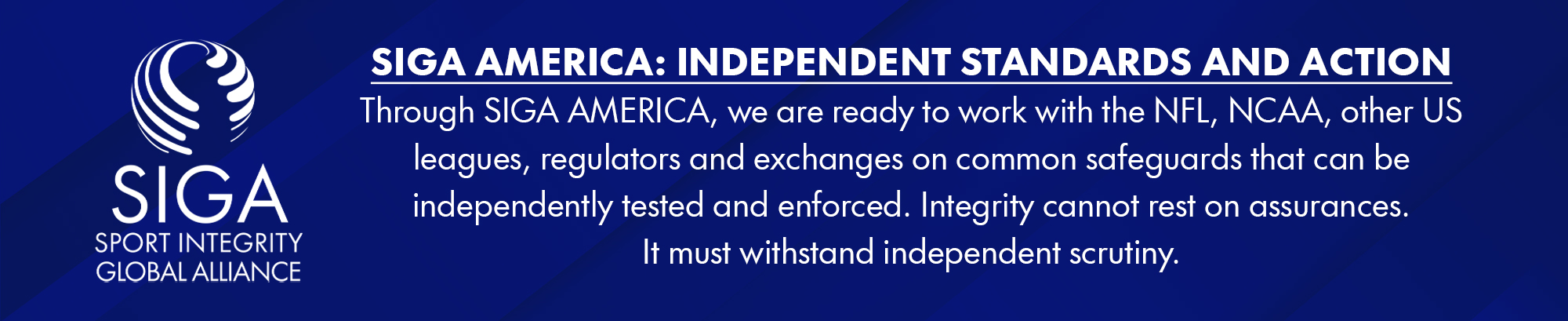
Sport does not need to start from zero. The Sport Integrity Global Alliance (SIGA), an independent coalition of sports organisations, public authorities and businesses, has developed the Universal Standards on Sports Betting Integrity. A suspicious trade should trigger prompt alerts to leagues and regulators, backed by access to the records investigators need. Through SIGA AMERICA, we are ready to work with the NFL, NCAA, other US leagues, regulators and exchanges on common safeguards that can be independently tested and enforced. Integrity cannot rest on assurances. It must withstand independent scrutiny.
The CFTC’s June proposal identifies contracts on injuries, officiating decisions and youth competitions as public-interest concerns. Those concerns must become enforceable limits. Protect young athletes: keep high school and other youth competitions off these markets, suspend college Sport contracts until safeguards are enforceable, and prohibit contracts on individual college athletes’ performances. Shut out manipulation: bar the high-risk categories identified by the NFL and review other vulnerable contracts before they are listed. Enforce accountability: verify users’ age and identity, set a US minimum of 21 for sports event contracts, restrict campus marketing, fund support for people harmed by gambling, and give athletes safe reporting channels backed by sanctions for abuse.
Kalshi says it screens sports insiders and monitors trading in real time. Regulators should require independent tests to determine whether those controls can detect insider trades placed through third-party accounts. Exchanges should promptly share alerts and relevant records with regulators and authorised integrity investigators. When suspicious trading threatens the integrity of a contest, regulators should be able to halt trading quickly and require exchanges to preserve the evidence.
SPORT MUST LEAD, NOT JUST PROFIT.
Innovation deserves encouragement. Regulatory loopholes do not. No business should be allowed to profit from the credibility of Sport while escaping responsibility for protecting it. When FIFA named ADI Predictstreet its official prediction market partner for the 2026 World Cup, it promised real-time monitoring and information sharing. FIFA should disclose whether those safeguards were independently tested and publish any findings. Every league and federation should require independent checks before lending its name to a prediction market or sportsbook and while the agreement is in force. Give independent integrity officers the authority to stop a deal the commercial team wants to keep.
Tomorrow, Tuesday, 17 November, the SIGA AMERICA Advisory Board will meet here in Boston. I will place these proposals before its members. In New York City, I intend to engage with leagues and regulators to advance a common response: clear limits on high-risk contracts, effective information-sharing, independent scrutiny and enforceable safeguards. Sport cannot afford to wait for the next integrity scandal before taking action.
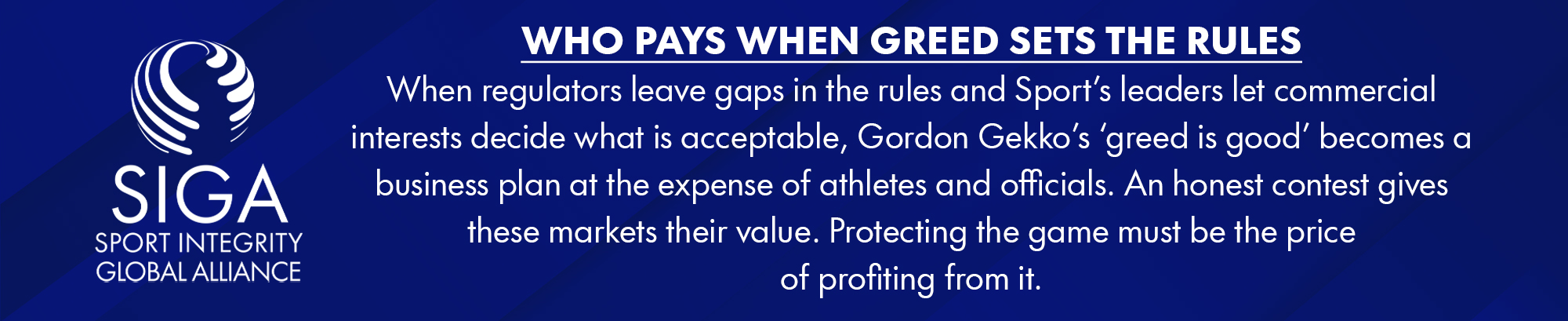
When regulators leave gaps in the rules and Sport’s leaders let commercial interests decide what is acceptable, Gordon Gekko’s “greed is good” becomes a business plan at the expense of athletes and officials. An honest contest gives these markets their value. Protecting the game must be the price of profiting from it.
– THE END –
ABOUT SIGA
SIGA is the world’s leading organisation for Sport Integrity. We are creating a whole new landscape for the sports industry by delivering independent global rating and certification for world Sport to ensure it is governed and operates under the highest integrity standards: The SIGA Universal Standards.
Funded by our Members, SIGA is a non for profit global independent organisation with one aim: To ensure the sport industry is governed under the highest integrity standards so that the values of sport are protected.
SIGA is the only organisation to bring together sport, governments, academia, international organisations, sponsors, business, rights holders, NGOs and professional services companies, from every region in the world, around a common cause of fostering greater integrity throughout sport.
SIGA is headquartered in Geneva, Switzerland, as a non for-profit association, and comprises of the following continental subsidiaries: SIGA AMERICA, SIGA ASIA, SIGA EUROPE and SIGA LATIN AMERICA.
For more information on SIGA, including its vision, mission and reform agenda, please refer to the website: www.siga-sport.com and FAQs.
To contact SIGA, please email: comms@siga-sport.com.
@Sigalliance – Twitter, Instagram, Linkedin | #SIGA #SIGAWoW