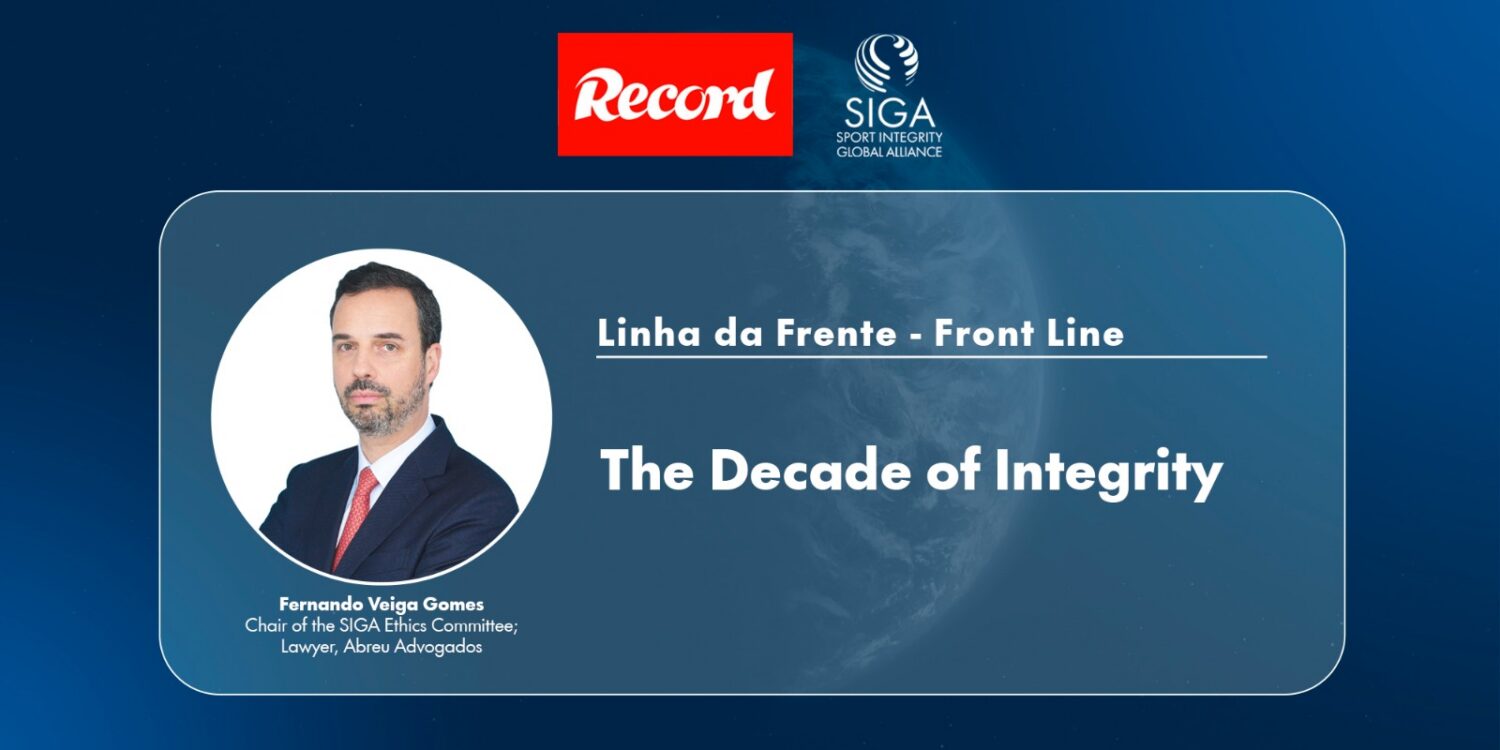
Launched on 4 June 2026 in Record, Portugal’s leading sports newspaper, SIGA’s weekly opinion column Linha da Frente (Front Line, in Portuguese) provides a dedicated platform to address issues at the heart of SIGA’s global agenda, including Sport Integrity, good governance, transparency, accountability, financial integrity, sports betting integrity, sustainability, youth development and protection, and the future of sport.
Click to read this week’s article in Portuguese.
The Decade of Integrity
Fernando Veiga Gomes
Chair of the SIGA Ethics Committee; Sports Lawyer, Abreu Advogados
Sport sells one thing above all else: fair competition. In the years ahead, integrity will cease to be a statement of principles and become the foremost legal and commercial requirement in the sector.
Tony Dungy, former NFL player and coach, defined integrity as the choice between what is convenient and what is right. In sport, that choice is made every day: by athletes, referees, club owners, and officials at federations and leagues. Everything else depends on it. Without integrity, there is no uncertainty of outcome and, without that, there are no fans, no sponsors and no market. Integrity is the sum of four things: fair competition, good governance, clean money and the protection of those involved in sport.
The past year has shown that no sport is immune. In Turkey, 371 of 571 professional referees held betting accounts, and more than a thousand players were suspended. In the US, an NBA betting investigation led to the arrest of 34 people, including a head coach and a player, while two MLB pitchers were accused of manipulating pitches for bettors. In England, an independent commission concluded that Manchester City had breached Premier League financial rules. FIFA itself is facing a governance crisis following a plan to open up the World Cup’s commercial rights to private investors, which has since been withdrawn.
Why will integrity dominate the next decade? First, there is the money: betting, private equity, media rights, sovereign wealth funds and multi-club ownership groups have transformed the economics of sport. Then there is data: micro-betting and prediction markets are turning every sporting moment into something that can be traded on and, consequently, manipulated. Governments are entering the field, bringing regulators, gambling legislation and criminal law into play. Sponsors and investors are demanding evidence of good governance. And artificial intelligence is both the most powerful detection tool and a new source of risk. In 2025, Sportradar detected 1,116 suspicious events worldwide, 618 of them in football.
Football illustrates how far things have come. From FIFAGate in 2015 to FIFA’s reforms in 2016; from UEFA’s financial sustainability rules to the judgments of the Court of Justice of the European Union in the Super League and Diarra cases; from the creation of an independent regulator in English football to the 2025 ruling by the Court of Arbitration for Sport (CAS), which upheld Crystal Palace’s exclusion from the Europa League. The trend is clear: self-regulation is no longer enough, and external scrutiny is the new normal.
The next test is multi-club ownership. Seven of the top ten clubs in the UEFA rankings belong to multi-club groups, whose numbers have grown from around 40 clubs in 2012 to more than 300 today. The risks are well known: a lack of transparency over the origin of funds, conflicts of interest between clubs, transfers below market value and exposure to money laundering. As Aleksander Čeferin has said, it is not a question of saying no to investment, but the rules must be strict. There is an urgent need for common universal standards on good governance, financial integrity, betting integrity and the protection of minors.
Other sports have moved responsibility for integrity beyond their governing bodies: athletics established the Athletics Integrity Unit, while tennis created the International Tennis Integrity Agency. In boxing, the IOC withdrew recognition of the IBA over poor governance.
By 2036, six trends will shape the sector: independent scrutiny becoming the rule; the state acting as referee; artificial intelligence cutting both ways; insider information emerging as the new match-fixing; scrutiny of club owners and verification of the origin of funds; and the protection of young people, gender equality and human rights becoming matters of integrity.
As the Sport Integrity Global Alliance (SIGA) stated in August 2026: “Public trust cannot rest on self-assessment or peer review. It requires genuinely independent scrutiny and credible certification.”
Integrity is not a cost. It is the product.
– THE END –
Previous Front Line articles
- Front Line Op-Ed: Sport Integrity – The Value of Trust (4 June 2026, Emanuel Macedo de Medeiros)
- Front Line Op-Ed: The Fight Against Corruption in Sport Is Far From Over — And We Cannot Afford to Look Away (10 June 2026, Richard Weber)
- Front Line Op-Ed: Trust: Football’s Silent Capital (11 June 2026, Emanuel Macedo de Medeiros)
- Front Line Op-Ed: The Trust Test (18 June 2026, Emanuel Macedo de Medeiros)
- Front Line Op-Ed: Fashion Has Joined Forces with Sport. Now It Needs to Help Make It Better (25 June 2026, Emanuel Macedo de Medeiros)
- Front Line Op-Ed: Integrity in Youth Football: Protecting the Future On and Off the Pitch (2 July 2026, Miguel Gouveia de Brito)
- Front Line Op-Ed: Digital Success, IP Protection and Sports Integrity (9 July 2026, Martin Bland)
- Front Line Op-Ed: Prevention Rather Than Cure: What the World Cup Leaves Behind on Preventing Integrity Issues (16 July, Paul Buck)
- Front Line Op-Ed: Separating the Wheat from the Chaff — and the Courage to Decide (23 July, João Paulo Almeida)
- Front Line Op-Ed: After the Greatest World Cup Ever, FIFA Faces Its Greatest Test (30 July, Emanuel Macedo de Medeiros)
- Front Line Op-Ed: Mentoring Beyond Careers: Shaping the Future of Sport (6 August, Laura Cordingley)
- Front Line Op-Ed: FIFA’s Democracy Needs a Firewall Between Money and Votes (13 August, Mohammed Hanzab)
- Front Line Op-Ed: Can the World Cup Be Privately Managed? (20 August, Fernando Veiga Gomes)
- Front Line Op-Ed: What If Governing Well Isn’t That Complicated? (27 August, Nuno Perestrelo)
- Front Line Op-Ed: The Liquidity Sport Lacks — and the Scrutiny Its Money Demands (27 August, João Paulo Almeida)
- Front Line Op-Ed: Why Sport Clubs Need to Work Together (10 August, Iain Lindsay)
- Front Line Op-Ed: The Human Rights Game – An Example from Argentina (17 September, Pablo Perel)
- Front Line Op-Ed: ‘Bets’, the Vulnerable, and the Temptation of Easy Politics (1 October, João Paulo Almeida)
- Front Line Op-Ed: From Vision to Action: A Month for Sport Integrity (8 October, Nuno Perestrelo)
- Front Line Op-Ed: Sport Integrity in Latin America: From Individual Effort to Institutional Commitment (15 October, Vinicius Sousa)
- Front Line Op-Ed: Sports Leaders, Gratitude and the Accountability We Still Lack (22 October, João Paulo Almeida)
- Front Line Op-Ed: Sport Integrity – From Written Rules to Organisational Accountability (29 October, Roberto Fiore)
- Front Line Op-Ed: Integrity is the legacy (5 November, Alessandra Priante)
ABOUT SIGA
SIGA is the world’s leading organisation for Sport Integrity. We are creating a whole new landscape for the sports industry by delivering independent global rating and certification for world Sport to ensure it is governed and operates under the highest integrity standards: The SIGA Universal Standards.
Funded by our Members, SIGA is a non for profit global independent organisation with one aim: To ensure the sport industry is governed under the highest integrity standards so that the values of sport are protected.
SIGA is the only organisation to bring together sport, governments, academia, international organisations, sponsors, business, rights holders, NGOs and professional services companies, from every region in the world, around a common cause of fostering greater integrity throughout sport.
SIGA is headquartered in Geneva, Switzerland, as a non for-profit association, and comprises of the following continental subsidiaries: SIGA AMERICA, SIGA ASIA, SIGA EUROPE and SIGA LATIN AMERICA.
For more information on SIGA, including its vision, mission and reform agenda, please refer to the website: www.siga-sport.com and FAQs.
To contact SIGA, please email: comms@siga-sport.com.