
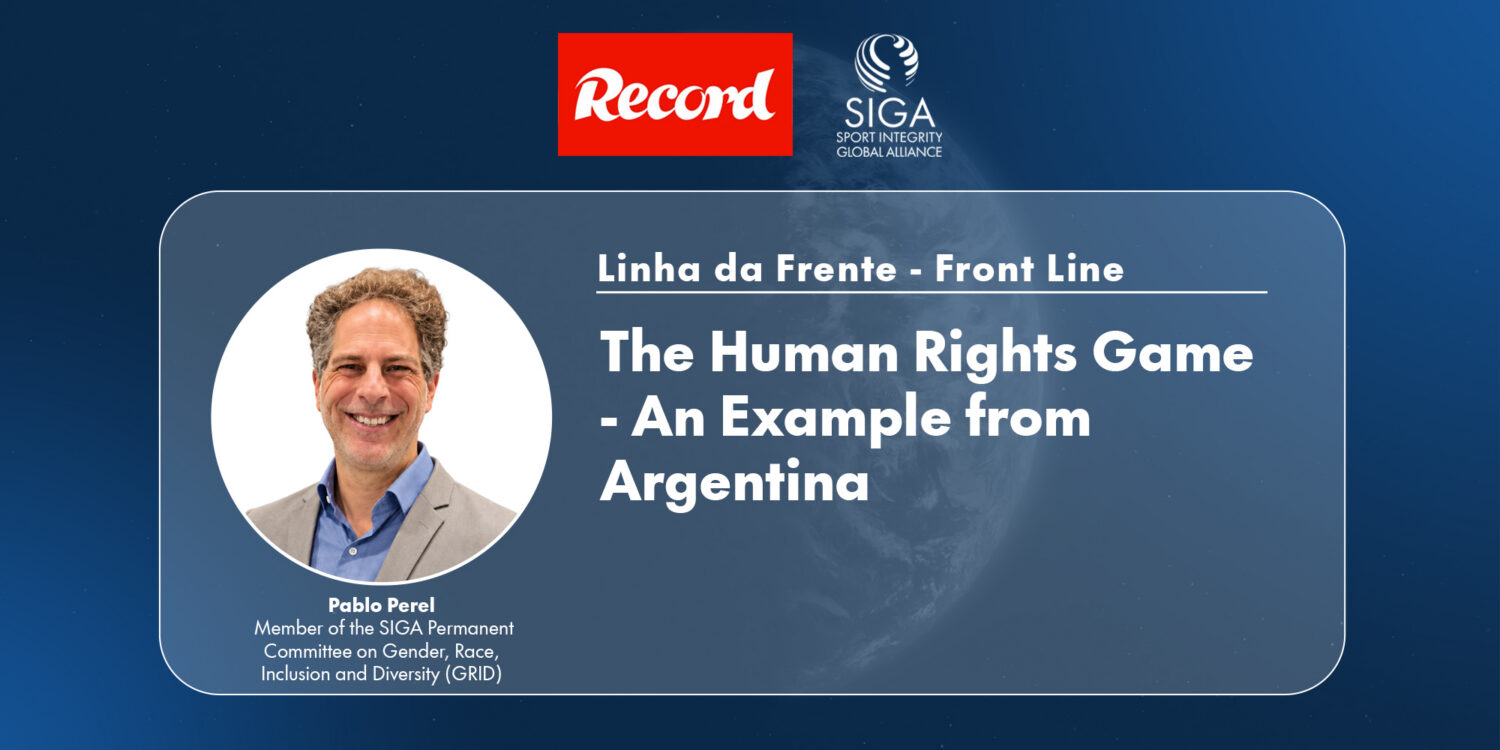
Launched on 4 June 2026 in Record, Portugal’s leading sports newspaper, SIGA’s weekly opinion column Linha da Frente (Front Line, in Portuguese) provides a dedicated platform to address issues at the heart of SIGA’s global agenda, including Sport Integrity, good governance, transparency, accountability, financial integrity, sports betting integrity, sustainability, youth development and protection, and the future of sport.
Click to read this week’s article in Portuguese.
The Human Rights Game — An Example from Argentina
By Pablo Perel, Member of the SIGA Permanent Committee on Gender, Race, Inclusion and Diversity (GRID)
South American football has historically been a faithful reflection of the tensions, passions and transformations of its societies. In the 21st century, however, the role of elite clubs has begun to transcend the purely competitive sphere, becoming a force for counterbalance and cultural evolution. Against this backdrop, Racing Club, one of Argentina’s giants, has established itself as a pioneering institution worldwide in the development of social and humanitarian policies. Through its Department of Gender and Human Rights, created during the presidency of Víctor Blanco, the “Academia” of Avellaneda has built an unprecedented model that redefines the meaning of integrity in the world’s game.
This area of the club promotes a profound cultural transformation aimed at eradicating violence, racism, xenophobia and gender discrimination. The principle underpinning its work is clear and unequivocal: football cannot function as a territory of exclusion, isolated from the problems of the community. The club is not simply about the 90 minutes of a weekend match; it is a school of citizenship and a space of cultural resistance where memory must be a daily practice, the team maintains. Under this vision, human rights issues are integrated across every level of club life, from mandatory training for the Board of Directors to the senior squads, coaching staff and youth teams.
The department’s work is firmly rooted in Argentine society’s historic commitment to the values of Memory, Truth and Justice. One of the most significant and impactful milestones of this work was the project to restore membership cards to supporters who disappeared during the last military dictatorship. The initiative consolidated under President Víctor Blanco required rigorous documentary research in the institution’s historical archives in order to symbolically restore the dignity and formal connection to the club of those who were victims of State terrorism.
Regarding this process of reparation, the club explained: “Restoring the social identity of our disappeared supporters is an act of justice that heals the institution’s social fabric. In doing so, we have demonstrated that Racing does not forget and that community bonds are indestructible.” This protocol had an enormous impact in Argentina and served as a model for other clubs within the national federation to adopt similar measures.
The department’s internal structure is also based on prevention and the implementation of rigorous protocols against gender-based violence, ensuring safe and equitable environments for all women and minorities who are part of the club, whether in the stands, changing rooms or offices. The institution’s vision, however, also extends beyond Argentina’s borders through strong regional cooperation.
Racing Club has established a network for exchanging experiences with major Latin American clubs, such as Corinthians and São Paulo in Brazil, and Pumas in Mexico, with the aim of strengthening institutional policies based on human rights. This joint effort places a particularly strong emphasis on combating racism and raising awareness of anti-racism in football.
By sharing sporting and social strategies with clubs such as Corinthians — which is heavily involved in global campaigns against racial discrimination — the aim is to dismantle intolerant behaviours deeply rooted in the South American and global football ecosystem.
The success of this management model has attracted international attention, leading Racing to present its methodologies at prestigious global forums such as the Sport Integrity Global Alliance (SIGA). The practical initiatives developed by the team, which also includes Bárbara Blanco, Alberto Di Sanzo and Cory Sdrubolini, among others, are directly aligned with the rigorous criteria of the SIGA Independent Rating and Verification System (SIRVS). Racing Club’s work directly addresses key pillars of the SIGA Universal Standards: Good Governance, Youth Protection and Development and, in particular, the new criteria focused on Social Sustainability and Human Rights in Sport.
Before global sports leaders, the club has demonstrated that genuine sport integrity goes far beyond financial transparency or the fight against doping; it is intrinsically linked to the active defence of human rights. The Racing Club case demonstrates that modern football can, and should, be a tool for inclusion, ethics and collective memory.
– THE END –
Previous Front Line articles
- Front Line Op-Ed: Sport Integrity – The Value of Trust (4 June 2026, Emanuel Macedo de Medeiros)
- Front Line Op-Ed: The Fight Against Corruption in Sport Is Far From Over — And We Cannot Afford to Look Away (10 June 2026, Richard Weber)
- Front Line Op-Ed: Trust: Football’s Silent Capital (11 June 2026, Emanuel Macedo de Medeiros)
- Front Line Op-Ed: The Trust Test (18 June 2026, Emanuel Macedo de Medeiros)
- Front Line Op-Ed: Fashion Has Joined Forces with Sport. Now It Needs to Help Make It Better (25 June 2026, Emanuel Macedo de Medeiros)
- Front Line Op-Ed: Integrity in Youth Football: Protecting the Future On and Off the Pitch (2 July 2026, Miguel Gouveia de Brito)
- Front Line Op-Ed: Digital Success, IP Protection and Sports Integrity (9 July 2026, Martin Bland)
- Front Line Op-Ed: Prevention Rather Than Cure: What the World Cup Leaves Behind on Preventing Integrity Issues (16 July, Paul Buck)
- Front Line Op-Ed: Separating the Wheat from the Chaff — and the Courage to Decide (23 July, João Paulo Almeida)
- Front Line Op-Ed: After the Greatest World Cup Ever, FIFA Faces Its Greatest Test (30 July, Emanuel Macedo de Medeiros)
- Front Line Op-Ed: Mentoring Beyond Careers: Shaping the Future of Sport (6 August, Laura Cordingley)
- Front Line Op-Ed: FIFA’s Democracy Needs a Firewall Between Money and Votes (13 August, Mohammed Hanzab)
- Front Line Op-Ed: Can the World Cup Be Privately Managed? (20 August, Fernando Veiga Gomes)
- Front Line Op-Ed: What If Governing Well Isn’t That Complicated? (27 August, Nuno Perestrelo)
- Front Line Op-Ed: The Liquidity Sport Lacks — and the Scrutiny Its Money Demands (27 August, João Paulo Almeida)
- Front Line Op-Ed: Why Sport Clubs Need to Work Together (10 August, Iain Lindsay)
ABOUT SIGA
SIGA is the world’s leading organisation for Sport Integrity. We are creating a whole new landscape for the sports industry by delivering independent global rating and certification for world Sport to ensure it is governed and operates under the highest integrity standards: The SIGA Universal Standards.
Funded by our Members, SIGA is a non for profit global independent organisation with one aim: To ensure the sport industry is governed under the highest integrity standards so that the values of sport are protected.
SIGA is the only organisation to bring together sport, governments, academia, international organisations, sponsors, business, rights holders, NGOs and professional services companies, from every region in the world, around a common cause of fostering greater integrity throughout sport.
SIGA is headquartered in Geneva, Switzerland, as a non for-profit association, and comprises of the following continental subsidiaries: SIGA AMERICA, SIGA EUROPE and SIGA LATIN AMERICA.
For more information on SIGA, including its vision, mission and reform agenda, please refer to the website: www.siga-sport.com and FAQs.
To contact SIGA, please email: comms@siga-sport.com.