
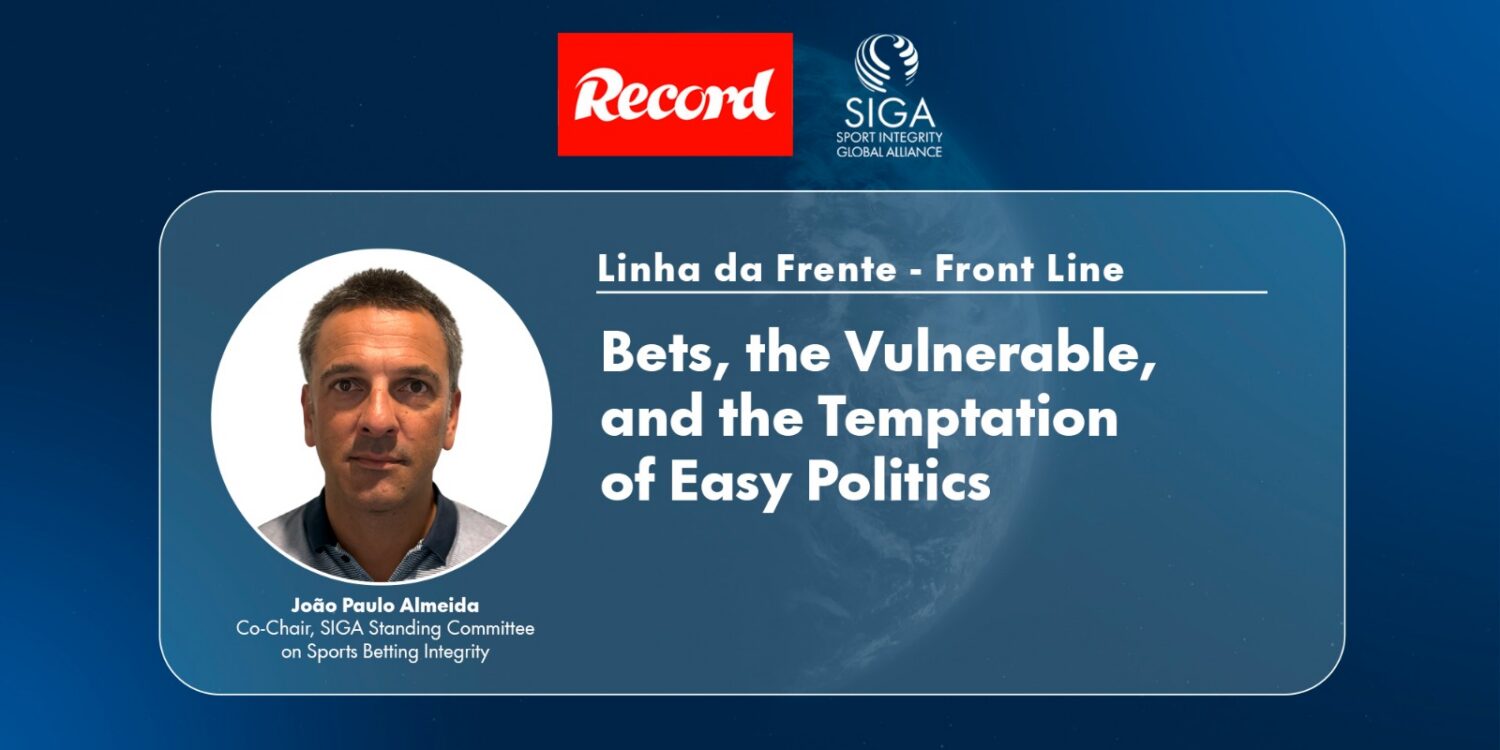
Launched on 4 June 2026 in Record, Portugal’s leading sports newspaper, SIGA’s weekly opinion column Linha da Frente (Front Line, in Portuguese) provides a dedicated platform to address issues at the heart of SIGA’s global agenda, including Sport Integrity, good governance, transparency, accountability, financial integrity, sports betting integrity, sustainability, youth development and protection, and the future of sport.
Click to read this week’s article in Portuguese.
Bets, the Vulnerable, and the Temptation of Easy Politics
By João Paulo Almeida
Co-Chair, SIGA Standing Committee on Sports Betting Integrity
Brazil has just banned bets (sports betting), only a few years after creating a regulated market for them, with licensed operators and dedicated oversight. The Provisional Measure of 25 September terminates existing licences and prohibits the operation, offering, and advertising of fixed-odds betting.
The government cites household indebtedness, and 71% of Brazilians support the ban. The harm is real, and protecting those most at risk is an obligation. But the measure comes just days before the presidential election, and it is precisely when a cause is popular, morally appealing, and involves vulnerable people that we should demand greater rigour, not less.
There is a familiar temptation in contemporary politics: take a real problem, identify an obvious culprit, and offer a simple solution. Bets are the culprit; prohibition is the solution.
In June, reviewing the first year of regulation, Carlos Renato Xavier, Undersecretary at the Secretariat of Prizes and Betting, described the model as successful and assured that the government would not retreat from regulation, but would intensify the fight against illegal operators. Three months later, it ended it. What changed? That was one of the central questions at the SIGA Ibero-American Sports Betting Integrity Forum, which I moderated on Tuesday in Lisbon, on the sidelines of the SBC Summit. And perhaps the most important question is not why Brazil imposed the ban, but what happens next. The problem does not disappear…
The indebted gambler, gambling addiction, and demand continue to exist after the legal platform has been shut down. And where there is demand, there is supply. In a regulated market, the State knows where the operator is, imposes rules, requires protection mechanisms, controls advertising, monitors transactions, and collects information. In an illegal market, it loses what it needs most: visibility.
The government’s response is a committee to combat illegal operations and the criminalisation of the activity. That is necessary, but not sufficient. By April, Brazil had already blocked more than 39,000 illegal domains. That is the scale of a market that lies outside the jurisdiction, protects no one, and shares data with no one.
This is critical to sport integrity. Combating competition manipulation requires monitoring and the sharing of information between operators, regulators, law enforcement, and sports organisations. Without a regulated market, that system loses one of its main sources of alerts. The phenomenon does not disappear. It becomes harder to see.
None of this is a defence of bets — that is, licensed betting operators. Many operators licensed in one country operate illegally in other jurisdictions, and those who license them cannot ignore that. What is at stake is regulation stringent enough not to confuse legalisation with permissiveness. Operators have responsibilities. Advertising requires limits, and the 79% of Brazilians calling for them are right to do so. The protection of minors and vulnerable gamblers cannot be a footnote. And sport cannot receive betting revenues without assuming proportionate responsibility for the integrity of competitions. Regulation does not mean letting operators do as they please.
But a State that abandons its own model must explain what failed, what alternatives it considered, and why prohibition will provide better protection. Announcing a ban is easy. Explaining how vulnerable gamblers will be protected, how the illegal market will be tackled, and how suspicious betting activity will be monitored is much harder. That is the difference between governing a problem and exploiting it politically. Vulnerable gamblers deserve protection, not instrumentalisation.
Banning the regulated market is a political decision. Solving the problem is another matter.
– THE END –
Previous Front Line articles
- Front Line Op-Ed: Sport Integrity – The Value of Trust (4 June 2026, Emanuel Macedo de Medeiros)
- Front Line Op-Ed: The Fight Against Corruption in Sport Is Far From Over — And We Cannot Afford to Look Away (10 June 2026, Richard Weber)
- Front Line Op-Ed: Trust: Football’s Silent Capital (11 June 2026, Emanuel Macedo de Medeiros)
- Front Line Op-Ed: The Trust Test (18 June 2026, Emanuel Macedo de Medeiros)
- Front Line Op-Ed: Fashion Has Joined Forces with Sport. Now It Needs to Help Make It Better (25 June 2026, Emanuel Macedo de Medeiros)
- Front Line Op-Ed: Integrity in Youth Football: Protecting the Future On and Off the Pitch (2 July 2026, Miguel Gouveia de Brito)
- Front Line Op-Ed: Digital Success, IP Protection and Sports Integrity (9 July 2026, Martin Bland)
- Front Line Op-Ed: Prevention Rather Than Cure: What the World Cup Leaves Behind on Preventing Integrity Issues (16 July, Paul Buck)
- Front Line Op-Ed: Separating the Wheat from the Chaff — and the Courage to Decide (23 July, João Paulo Almeida)
- Front Line Op-Ed: After the Greatest World Cup Ever, FIFA Faces Its Greatest Test (30 July, Emanuel Macedo de Medeiros)
- Front Line Op-Ed: Mentoring Beyond Careers: Shaping the Future of Sport (6 August, Laura Cordingley)
- Front Line Op-Ed: FIFA’s Democracy Needs a Firewall Between Money and Votes (13 August, Mohammed Hanzab)
- Front Line Op-Ed: Can the World Cup Be Privately Managed? (20 August, Fernando Veiga Gomes)
- Front Line Op-Ed: What If Governing Well Isn’t That Complicated? (27 August, Nuno Perestrelo)
- Front Line Op-Ed: The Liquidity Sport Lacks — and the Scrutiny Its Money Demands (27 August, João Paulo Almeida)
- Front Line Op-Ed: Why Sport Clubs Need to Work Together (10 August, Iain Lindsay)
- Front Line Op-Ed: The Human Rights Game – An Example from Argentina (17 September, Pablo Perel)
ABOUT SIGA
SIGA is the world’s leading organisation for Sport Integrity. We are creating a whole new landscape for the sports industry by delivering independent global rating and certification for world Sport to ensure it is governed and operates under the highest integrity standards: The SIGA Universal Standards.
Funded by our Members, SIGA is a non for profit global independent organisation with one aim: To ensure the sport industry is governed under the highest integrity standards so that the values of sport are protected.
SIGA is the only organisation to bring together sport, governments, academia, international organisations, sponsors, business, rights holders, NGOs and professional services companies, from every region in the world, around a common cause of fostering greater integrity throughout sport.
SIGA is headquartered in Geneva, Switzerland, as a non for-profit association, and comprises of the following continental subsidiaries: SIGA AMERICA, SIGA EUROPE and SIGA LATIN AMERICA.
For more information on SIGA, including its vision, mission and reform agenda, please refer to the website: www.siga-sport.com and FAQs.
To contact SIGA, please email: comms@siga-sport.com.