
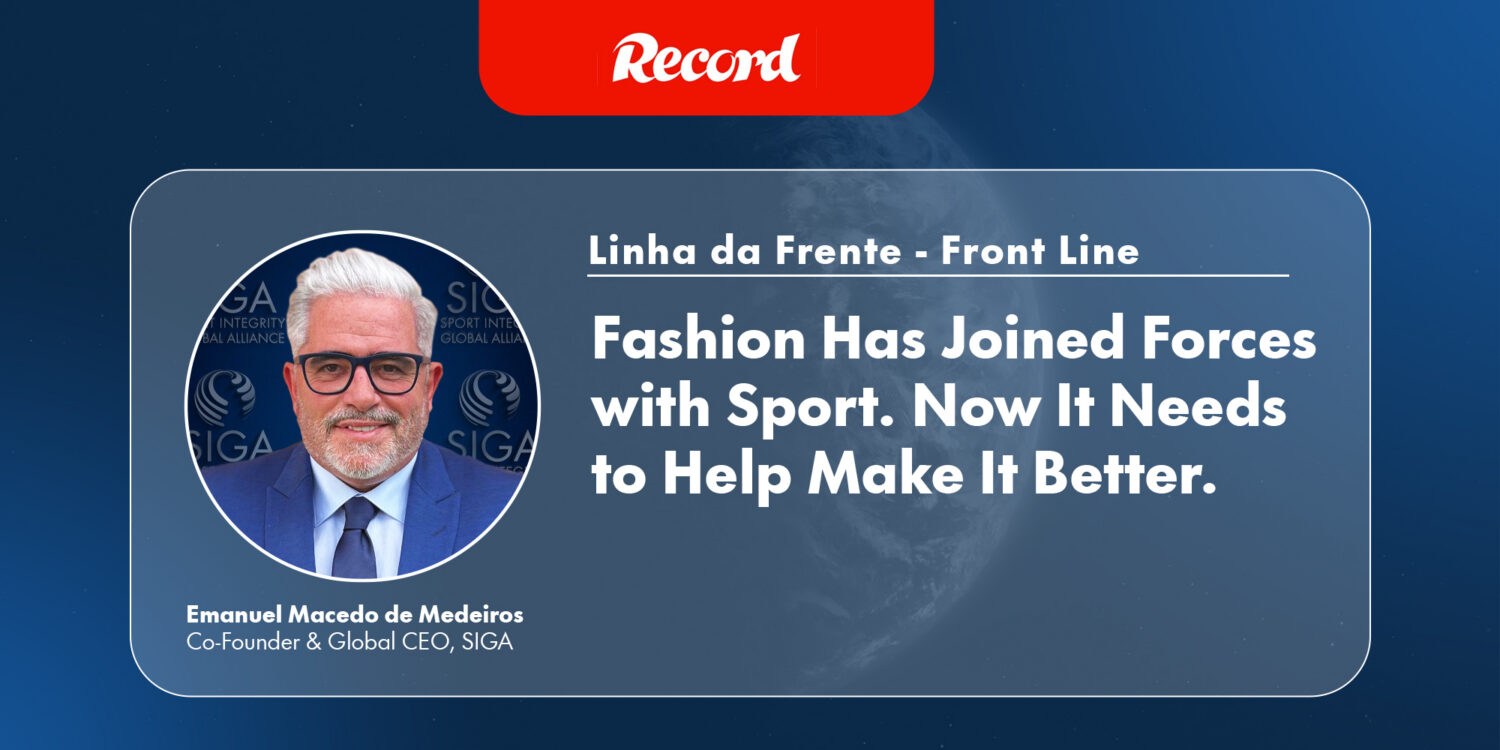
Launched on 4 June 2026 in Record, Portugal’s leading sports newspaper, SIGA’s weekly opinion column Linha da Frente (Front Line, in Portuguese) provides a dedicated platform to address issues at the heart of SIGA’s global agenda, including Sport Integrity, good governance, transparency, accountability, financial integrity, sports betting integrity, sustainability, youth development and protection, and the future of sport.
Click to read this week’s article in Portuguese.
Fashion Has Joined Forces with Sport. Now It Needs to Help Make It Better
By Emanuel Macedo de Medeiros
Founder and Global CEO, SIGA
Yesterday, in Cannes, at one of the most iconic addresses on the Croisette, I brought together leaders from sport and the creative industries for a conversation that rarely takes place on the stages where it should.
The choice of this moment and this setting was no coincidence.
Three decades on the front lines of sport — including as CEO of the European Leagues and the World Leagues Association, and now at the helm of SIGA — have taught me one thing: major transformations are often born from outside influences and from the intersection of different industries, cultures and ways of looking at the world.
We are witnessing one such transformation today.
Gucci has become Alpine’s principal partner in Formula 1 from 2027 onwards — the first luxury fashion house to assume that role at the pinnacle of world motorsport, in a deal estimated to be worth more than $150 million. LVMH has committed $1 billion over ten years to Formula 1. Louis Vuitton carries the FIFA World Cup Trophy in a monogrammed trunk. Chaumet designed the medals for Paris 2024. Berluti dressed the 1,500 French athletes for the Opening Ceremony. Dior is the official formalwear partner of Paris Saint-Germain. Ralph Lauren is outfitting Team USA for the Olympic Games for the ninth consecutive time. And in Portugal, Suits Inc dresses Benfica and FC Porto, proving that this transformation is not only global; it is also taking place at home.
Fashion and the creative industries have become part of the sporting ecosystem — and they are here to stay.
Sport has come to understand what they bring beyond revenues: desirability, identity, cultural relevance and an emotional connection that extends far beyond the result. And they, in turn, have recognised what sport offers beyond customers: global audiences, live emotion, genuine loyalty and moments that cannot be manufactured.
The question is no longer whether fashion belongs in sport. The question is what it will do with the influence it has acquired within it: merely embellish the spectacle — or become a force for transformation?
When I led the European Leagues and the World Leagues Association, I was quick to build bridges with the creative industries. We faced common threats: digital piracy and the cannibalisation of intellectual property rights. Counterfeit licensed products. Ambush marketing that exploited the visibility of events without contributing to their financing. Sport and culture shared the same enemies. It was obvious that only together would we have the strength to confront them.
Today, the battle is different — but the logic remains the same.
If fashion, luxury and culture are now structurally embedded within sport, what will they do with that position? Make it more attractive? Certainly. More profitable? Without question. But more ethical? More transparent? More accountable to the athletes, the fans and the communities that sustain it?
That is a different conversation. And it is precisely the conversation that SIGA wants to have.
Let us be clear: this is not about attributing any moral superiority to fashion or the creative industries over sport. They too face their own challenges and carry their own responsibilities. This is not about one industry lecturing another. It is about recognising that when sectors with such economic, cultural and social weight intersect, so too do their responsibilities.
Integrity in sport is not a technical issue. It is a matter of culture. It is the sum of the decisions made when no one is watching. It is the environment created within a federation, a league, a club or an event. It is about the values that are — or are not — passed on to the next generation.
And this is where fashion, cinema, music and entertainment have an irreplaceable role to play. These industries possess something that sport, on its own, isolated and trapped in the past, cannot manufacture: the ability to shape what is perceived as desirable, aspirational and normal. They can make integrity, transparency and accountability not merely obligations, but values with which people identify and genuinely want to uphold.
Sport gives culture one of the greatest stages in the world. More than 1.5 billion people follow Formula 1. More than 5 billion follow football. The FIFA World Cup and the Olympic Games are the largest media events on the planet.
This is where the conversation ceases to be only about fashion, image or visibility — and becomes equally about influence, investment and responsibility.
Because when a brand joins forces with sport, it is not simply buying media exposure. It is associating its name, reputation and values with the athletes, organisations and competitions it chooses to support. Every partnership is a choice. And every choice carries a message about the values a brand is willing to promote, legitimise and finance.
At SIGA, the responsibility we ask brands to embrace is clear: use your influence to make integrity more visible, more aspirational and more central to the culture of sport. But also use your economic power to raise the bar before investing.
Before associating your brand, reputation and credibility with a federation, league, club, event or athlete, ask whether that organisation has adopted, implemented and complies with SIGA’s Universal Standards on integrity, good governance, transparency and accountability.
If the answer is no, do not invest without first demanding the adoption of those standards. Because associating your reputation with organisations that reject independent standards of integrity is not an investment strategy. It is reputational Russian roulette.
Because a sport with greater integrity is not simply a more ethical sport. It is a more sustainable, more credible and, ultimately, more valuable one for everyone who invests in it.
Fashion taught sport how to dress better. Now it can help it govern better.
– THE END –
Previous Front Line articles
ABOUT SIGA
SIGA is the world’s leading organisation for Sport Integrity. We are creating a whole new landscape for the sports industry by delivering independent global rating and certification for world Sport to ensure it is governed and operates under the highest integrity standards: The SIGA Universal Standards.
Funded by our Members, SIGA is a non for profit global independent organisation with one aim: To ensure the sport industry is governed under the highest integrity standards so that the values of sport are protected.
SIGA is the only organisation to bring together sport, governments, academia, international organisations, sponsors, business, rights holders, NGOs and professional services companies, from every region in the world, around a common cause of fostering greater integrity throughout sport.
SIGA is headquartered in Geneva, Switzerland, as a non for-profit association, and comprises of the following continental subsidiaries: SIGA AMERICA, SIGA EUROPE and SIGA LATIN AMERICA.
For more information on SIGA, including its vision, mission and reform agenda, please refer to the website: www.siga-sport.com and FAQs.
To contact SIGA, please email: comms@siga-sport.com.