
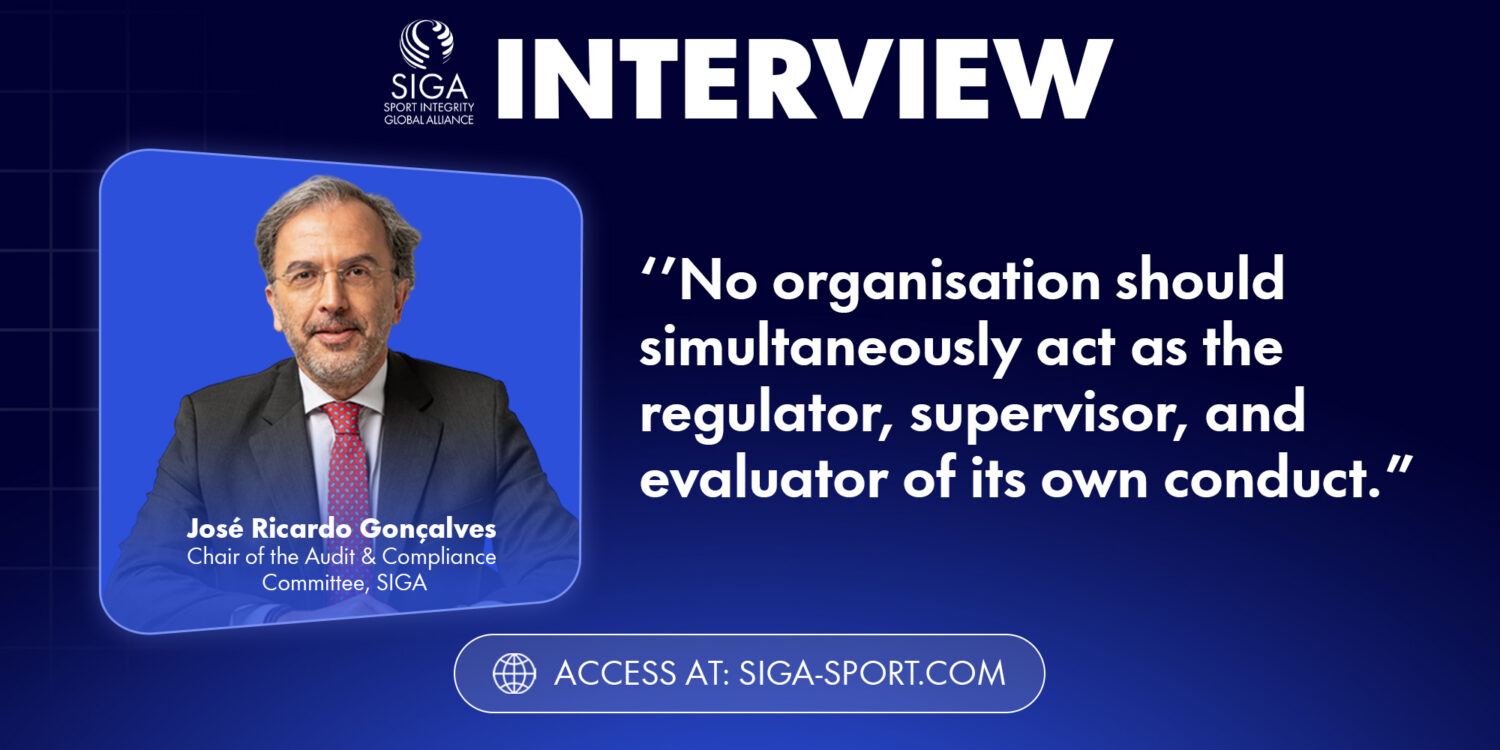
At a time when sports organisations are facing growing expectations for transparency, independent oversight, and demonstrable accountability, this interview with José Ricardo Gonçalves, Chair of SIGA’s Audit & Compliance Committee, examines what it takes to move from compliance on paper to integrity in practice.
Drawing on his legal, governance, and sports arbitration experience, José Ricardo Gonçalves reflects on the importance of effective oversight, institutional independence, and accountability, and on why codes of ethics, compliance policies, and formal controls are only meaningful when they are consistently implemented, monitored, and enforced. The conversation also addresses some of the most significant risks currently facing sports organisations — from conflicts of interest and financial misconduct to regulatory exposure and reputational damage — and the practical measures that boards and senior executives can adopt to identify vulnerabilities before they develop into institutional crises.
José Ricardo Gonçalves was elected Chair of SIGA’s Audit & Compliance Committee in 2026. He is a Partner at RBMS – Rodrigues Bastos, Magalhães e Silva & Associados, where his practice includes Sports Law, Criminal Law, and Labour Law. He is also an Arbitrator and Vice-President of Portugal’s Court of Arbitration for Sport, and an Arbitrator at the European Handball Court of Arbitration.
Bringing together his experience in law, arbitration, compliance, and sports governance, he offers a clear perspective on a central challenge for modern sport: how organisations can build credibility not simply by adopting rules, but by demonstrating that those rules work in practice — independently, consistently, and with real accountability.
Drawing on your role as Chair of SIGA’s Audit & Compliance Committee, what lessons can sports organisations take from SIGA’s approach to audit, compliance and institutional accountability, particularly at a time when stakeholders are demanding greater transparency, independence and effective oversight?
JOSÉ RICARDO GONÇALVES – The principal lesson sports organisations can draw from SIGA’s experience is straightforward: integrity cannot depend solely on the existence of rules — on what is written on paper. It must also be reflected in their effective implementation, verified through monitoring, independent oversight, training and prevention, and ultimately supported by effective mechanisms to ensure accountability when those rules are breached.
If we recall SIGA’s five GOALS — Good Governance, Outstanding Ethical Conduct, Accountability, Legality and Scrutiny — it is entirely understandable that sports organisations wish to preserve their autonomy. But that autonomy should be subject to independent scrutiny, which in turn strengthens their legitimacy. Sports organisations should be open to audit and should implement effective and efficient compliance mechanisms, while also ensuring that external and independent assessment is available. This is precisely the purpose of SIRVS, developed by SIGA to provide sports organisations with independent assessment, rating, verification and certification. A code of ethics, an anti-corruption policy or a conflicts-of-interest regulation is not, in itself, synonymous with integrity and transparency. What matters is that all written compliance rules are applied in practice and operate coherently as part of an integrated framework.
It is equally essential that audit and compliance functions have genuine institutional autonomy. An Audit & Compliance Committee should not be merely advisory. On the contrary, it should have access to relevant information, the authority to challenge decisions and make binding recommendations, independence from executive bodies, and a direct reporting line to the organisation’s supervisory body. SIGA itself has both an Audit & Compliance Committee and an Ethics Committee, each operating with independent status.
Accountability must also be measurable. The model developed by SIGA therefore seeks to translate abstract principles — integrity, transparency, good governance and accountability — into standards, indicators, levels of implementation and verification processes. The Universal Standards follow a progressive Bronze, Silver and Gold framework, enabling organisations to measure their progress towards greater integrity and transparency and, through a structured and constructive process, implement the improvements identified.
Finally, there is the question of trust. In today’s sporting landscape, sponsors, investors, athletes, fans, public authorities and other stakeholders want to know what rules are in place, who oversees them, what controls exist, which risks have been identified, what irregularities have been detected and what action has been taken. In the words of Giovanni Tartaglia Polcini, Independent Chair of SIGA, “Spectators, athletes, sponsors and investors must have confidence that sporting outcomes are determined by merit, talent, preparation and fair play, rather than by corruption, manipulation or undue influence. Trust is the invisible infrastructure upon which our societies function. Every financial transaction depends upon trust. Every institution depends upon trust. Every market depends upon trust. Every sporting competition depends upon trust. Every democratic society depends upon trust.”
SIGA leads by example. It does not simply advocate for integrity in sport; it has committed to subjecting its own governance to independent assessment against the same standards it promotes across the sports ecosystem, thereby strengthening its own institutional credibility. A new culture of sports governance must therefore build trust through independence, evidence, verification and accountability. Audit and compliance should be understood as active governance tools that improve the quality of decision-making, rather than merely as mechanisms designed to prevent breaches of internal rules, external regulations or the law.
Many organisations have codes of ethics, compliance policies and formal control mechanisms in place, yet serious governance failures still occur. In your experience, what distinguishes a genuine culture of integrity from a compliance framework that exists primarily on paper?
JRG – There is often a significant gap between what an organisation publicly says it does and what it actually does when confronted with situations that require the practical and effective application of the rules it has put on paper.
As I have said, it is not enough to adopt a code of ethics, approve compliance policies or establish control mechanisms. The real test of a genuine culture of integrity and transparency comes when an organisation has to investigate an influential individual, acknowledge a management failure, or take a decision that may adversely affect its own financial interests in order to safeguard its integrity and protect its institutional standing and reputation.
A culture of integrity and transparency therefore starts at the top. Leadership must set the tone and demonstrate, through its decisions and conduct, that the rules apply to everyone, irrespective of position, status, seniority or influence within the organisation. There can be no genuine culture of integrity where there is a gap between what an organisation demands of others and what it is prepared to demand of itself — or of certain individuals within its own ranks.
We must all recognise that integrity requires independence and institutional courage. Those responsible for compliance, audit and ethics must have the autonomy to challenge decisions, investigate potentially irregular conduct — subject only to the limitations imposed by law — and report their findings to the competent bodies without fear of adverse consequences or retaliation.
It is also essential to move beyond formal compliance and ethics policies towards genuine accountability for how those policies are implemented in practice. The existence of a written policy is not enough: it must be known, understood, applied, open to scrutiny and, above all, effective when a breach occurs. A true culture of integrity is one in which people feel responsible not only for complying with the rules, but also for protecting the organisation’s values. That requires an environment in which concerns can be raised openly, those who report wrongdoing in good faith are protected from retaliation, failures are identified and corrected, recurrence is prevented, and those responsible are held to account.
So, rather than asking only whether an organisation “has a code of conduct and a policy for the prevention of corruption and related offences”, we should also ask: “What happens when someone breaches that code or policy?” If the answer is clear, objective, independent, consistent and therefore credible, then there is evidence of a transparent culture of integrity. If the answer depends on who is involved, how much influence they wield or the potential reputational consequences of the case, then compliance and ethics exist on paper, but not as a genuine culture of integrity.
Sports organisations must be prepared to subject their own structures and practices to the same standards of integrity, ethics, transparency, independence, legality, scrutiny, good governance and accountability that they advocate for the wider sports system. In other words, they should not demand of others what they are unwilling to demand of themselves.
From a legal and governance perspective, what are the most significant audit, compliance and accountability risks currently facing sports organisations, and what practical measures should boards and senior executives adopt to identify and address those risks before they develop into institutional crises?
JRG – I would identify five major areas of risk.
The first is a lack of independent oversight and of effective mechanisms enabling oversight bodies to perform their functions. This creates a significant risk that decisions will not be scrutinised adequately and that irregularities will not be detected at an early stage.
The second is conflicts of interest and a lack of transparency. In sport, where complex relationships frequently exist between officials, clubs, federations, sponsors, agents, investors and other stakeholders, it is essential to identify and properly manage situations in which personal interests may influence institutional decision-making. Here again, having a conflicts-of-interest policy is not enough. Organisations must ensure that it is effectively implemented, continuously reviewed and properly monitored, and that individuals who fail to recuse themselves from decision-making when faced with a conflict of interest are held accountable and that such breaches are appropriately disclosed.
The third is financial integrity and the risk of fraud, corruption, match-fixing, illegal betting and other unlawful conduct. Sports organisations manage significant financial resources and often operate through increasingly complex national and transnational structures, while those engaged in illicit practices make use of ever more sophisticated and innovative methods. Such conduct damages sport and seriously undermines the credibility and integrity of competitions. Its effects go beyond individual results or competitions: it erodes the trust of fans and sponsors and can damage the image and reputation of athletes. Robust internal controls, continuous monitoring, segregation of duties, transaction traceability, training, reporting mechanisms and cooperation with the relevant authorities are therefore essential preventive tools.
The fourth is regulatory and compliance risk. Sports organisations are subject to a growing range of obligations — from governance requirements and rules governing the organisation, management and disciplinary oversight of their activities, to data protection, anti-corruption and anti-money-laundering requirements, as well as obligations relating to sustainability and the integrity of competitions. The challenge is not simply to be aware of these rules, but to ensure that the organisation has the internal capacity to implement them effectively through concrete procedures, independent oversight of compliance and continuous monitoring of regulatory developments.
Finally, there is reputational risk and the risk of losing trust. Today, a governance failure can become public within hours and rapidly acquire global visibility, with potentially devastating consequences for an organisation. Reputation can no longer be treated solely as a communications issue; it is also a direct consequence of good governance. And, as I noted earlier, trust can no longer simply be asserted — it must be demonstrated.
As for practical measures, those responsible for governing sports organisations should begin by asking themselves: “What risks could undermine the integrity, transparency and credibility of our organisation, and are we prepared to detect and prevent them?”
From there, I would highlight the importance of the following measures:
First, conduct regular and independent risk assessments that go beyond financial risk to include legal, regulatory, ethical and reputational risks — in short, risks to the organisation’s integrity.
Second, ensure a genuinely independent audit and compliance function, with adequate resources, direct access to the governing or supervisory body, and sufficient autonomy and authority to investigate and report risk-related matters.
Third, implement effective whistleblowing mechanisms and robust protection for those who report concerns in good faith. An organisation should want to know when something is wrong or inconsistent with its compliance rules and ethical principles; it should investigate the matter, not conceal it. A whistleblowing mechanism should not be viewed as a threat to the organisation, but as an early-warning system that helps identify weaknesses, drive improvements, prevent future misconduct and, ultimately, strengthen trust in the organisation.
Fourth, undertake independent external audits and assessments, including by reference to SIGA’s Universal Standards. No organisation should simultaneously act as the regulator, supervisor and evaluator of its own conduct.
Fifth, organisations should impose rigorous, consistent and meaningful sanctions on those responsible for serious misconduct, including corruption or match-fixing. Enforcement should be combined with continuous education on the importance of integrity — applying the three Rs: recognise, resist and report — so that those involved in sport understand not only the rules themselves, but also the damage such conduct can cause to their careers and to public trust in sport.
In conclusion, sports organisations must send a clear message, internally and externally, that there is zero tolerance for conduct that compromises fair play, integrity or the trust of fans, athletes, sponsors and society at large. They must act preventively, rather than only after a crisis has occurred. In this context, SIGA, as an independent global movement, provides a platform that brings together representatives from sport, business and civil society to promote the highest standards of transparency, accountability and ethical conduct in relation to sport integrity. It supports education, encourages adherence to universal standards and principles through verifiable standards, assessment mechanisms and continuous improvement processes, facilitates the sharing of best practice, and promotes collective responsibility.
A well-governed sports organisation is not one that can claim never to have encountered problems. It is one that can demonstrate that it identifies and monitors risks, responds swiftly and effectively when warning signs or breaches arise, and holds the appropriate individuals accountable, regardless of their position or influence.
– THE END –
ABOUT SIGA
SIGA is the world’s leading organisation for Sport Integrity. We are creating a whole new landscape for the sports industry by delivering independent global rating and certification for world Sport to ensure it is governed and operates under the highest integrity standards: The SIGA Universal Standards.
Funded by our Members, SIGA is a non for profit global independent organisation with one aim: To ensure the sport industry is governed under the highest integrity standards so that the values of sport are protected.
SIGA is the only organisation to bring together sport, governments, academia, international organisations, sponsors, business, rights holders, NGOs and professional services companies, from every region in the world, around a common cause of fostering greater integrity throughout sport.
SIGA is headquartered in Geneva, Switzerland, as a non for-profit association, and comprises of the following continental subsidiaries: SIGA AMERICA, SIGA EUROPE and SIGA LATIN AMERICA.
For more information on SIGA, including its vision, mission and reform agenda, please refer to the website: www.siga-sport.com and FAQs.
To contact SIGA, please email: comms@siga-sport.com.