
At a time when the crisis of confidence affecting FIFA has placed governance, transparency, and genuine independent scrutiny at the centre of the international sports agenda, and when UEFA, the Asian Football Confederation (AFC) and CONCACAF have publicly called for greater accountability and credible external review, SIGA interviewed António José Silva, President of SIGA Member European Aquatics, and member of the SIGA Council.
Published as the European Aquatics Championships in Paris draw to a close, the interview comes at a particularly timely moment. Having made good governance a strategic priority upon taking office, Silva led European Aquatics through SIGA’s gap analysis and subsequent assessments under the Sport Integrity Rating and Verification System (SIRVS).
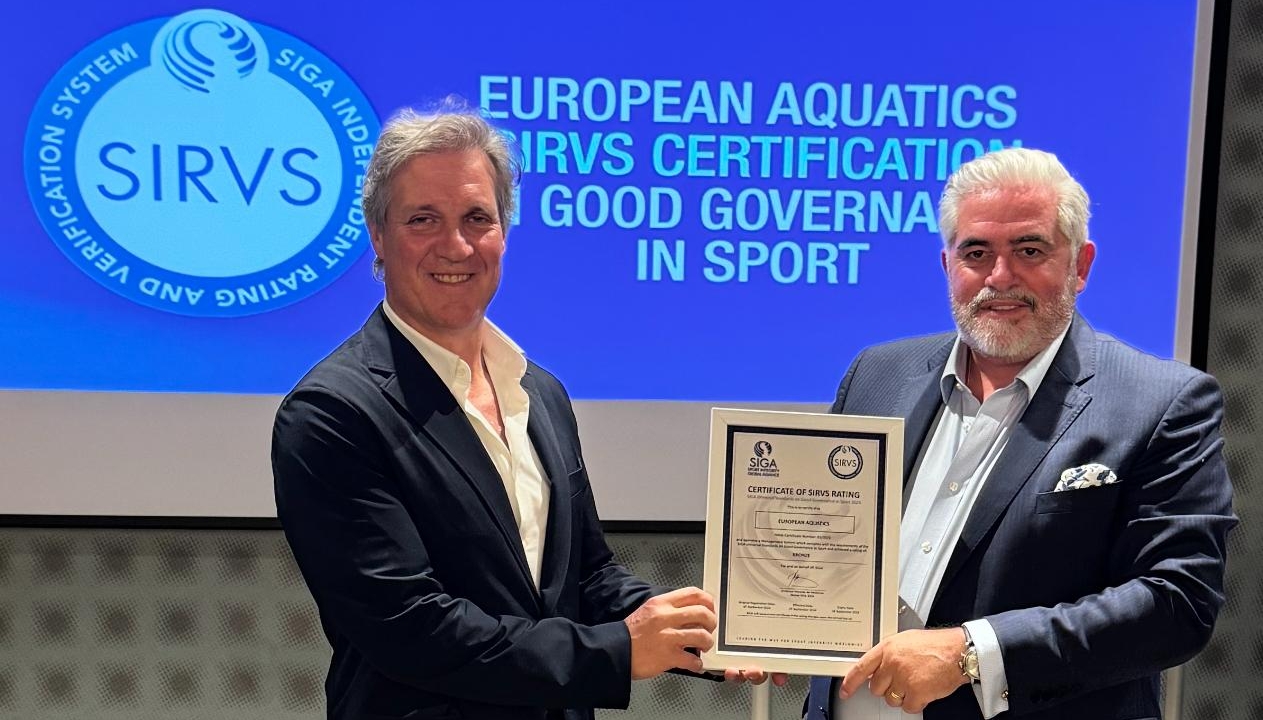
Last month, European Aquatics completed its second annual SIRVS review for Good Governance in Sport and again achieved bronze certification. In this interview, he reflects on how that journey turned a commitment to reform into measurable progress, and why it offers a constructive example for sport more broadly.
When you were elected President of European Aquatics, why did you make good governance an early priority?
António José Silva: From the outset, I believed that European Aquatics had to match its sporting ambition with an equally strong commitment to governance, transparency, and accountability. These are not peripheral matters. They are fundamental to the credibility, resilience, and long-term success of any international sports organization.
Good governance was therefore not treated as a one-off project. It became a strategic priority for the organization.
SIGA helped us turn good governance from a priority into measurable progress. When a new President takes office, as I did, there is often no efficient and independent way to diagnose the governance framework they have inherited. How can you build a legacy without first understanding the current state of the organization and how it compares with best-in-class standards specifically tailored to the sports industry?
We began with an independent and confidential gap analysis against SIGA’s Bronze-level standard. This revealed areas of both major and minor non-conformity in relation to SIGA’s Universal Standards on Good Governance in Sport.
The result was, to be frank, more challenging than I had anticipated. However, this gave us something very valuable: an objective starting point. We were then able to use the findings of the gap analysis, together with the Corrective Action Plan proposed by the audit team, as a central element of our strategic governance reforms and to mark the beginning of a new phase of enhanced governance for our European federation.
We repeated the gap-analysis process several times over a two-year journey and followed a structured roadmap for improvement. This included holding several General Assemblies to approve important constitutional changes before submitting our progress to independent assessment through the SIRVS certification system.
I am proud to say that last month, European Aquatics completed its second annual SIRVS review and once again achieved Bronze-level certification.
This continuing process has helped us strengthen European Aquatics for the benefit of athletes, Member Federations, partners, and the wider aquatics community. We are now working towards achieving the silver level as part of our commitment to continuous improvement.
Why did European Aquatics begin with a SIGA gap analysis before progressing to the full SIRVS assessment?
António José Silva: The gap analysis was an essential first step. It gave us a detailed and objective understanding of our governance arrangements against SIGA’s Universal Standards on Good Governance in Sport.
It enabled us to recognize the areas in which we were already performing well, while also identifying where further work was needed. Crucially, it provided us with a structured roadmap: clear priorities, practical recommendations, and a reliable basis on which to make improvements, including improving the efficiency of our federation.
Having undertaken that work, progressing to SIRVS was the natural next step. We wanted the progress we had made to be independently assessed and verified.
That is how an organization moves from aspiration to demonstrable achievement.
 As mentioned, last month European Aquatics completed its second annual SIRVS review for Good Governance in Sport and again achieved bronze certification. What does that result mean to you?
António José Silva: It demonstrates that sustained reform produces results.
Retaining Bronze certification in our second annual SIRVS review is important external recognition of the progress European Aquatics has made since we began this journey. It confirms that the work undertaken was meaningful, structured and capable of being independently evidenced.
The SIRVS assessment provides a snapshot of how an organization operates at a particular point in time. The certification is valid for a three-year cycle, with annual reviews in years two and three. During that period, an organization’s rating can change, so we are very pleased to have maintained our bronze level.
However, certification is not a finishing line. Good governance requires constant attention and continuous improvement. The greatest value of the process has been that it has strengthened our organization, embedded better practices and provided a clear foundation on which we can continue to build, with the ambition of continuously improving and strengthening our structure and processes.
 What did SIGA’s Universal Standards and SIRVS contribute to that progress?
António José Silva: SIGA’s Universal Standards and SIRVS gave us both the framework and the discipline to translate a leadership priority into an accountable and manageable process of reform.
The Universal Standards set out clear and internationally relevant principles, while the gap analysis and SIRVS provided the methodology to assess our position, address identified gaps and demonstrate progress.
That combination is particularly valuable. It is not simply about declaring support for good governance. It is about being able to demonstrate, through independent verification, what has been achieved and where further work remains necessary.
There is currently an important debate around governance, transparency and independent scrutiny in international football. What does European Aquatics’ experience suggest to the wider sporting world?
António José Silva: European Aquatics’ experience shows that there is a constructive and credible route for sports organisations wishing to strengthen confidence in their governance.
This is about recognising that transparency, accountability and independent scrutiny strengthen sport. They protect institutions, support leaders acting in good faith and give athletes, fans, partners and the public greater confidence.
Other industries accept independent scrutiny. Sport should be no different.
As the custodian of aquatics in Europe, European Aquatics has a responsibility to demonstrate that the organisation operates in accordance with sound governance principles, including democracy, transparency and stakeholder representation.
European Aquatics is a long-standing Member of SIGA, and you are a member of SIGA’s Council. Could that be seen as influencing your positive assessment of the SIGA Universal Standards and SIRVS?
António José Silva: The sequence is important. European Aquatics was already a Member of SIGA before I became President, but in many respects, it was a dormant membership. When I assumed the leadership of the organisation, I properly assessed what being part of SIGA could offer European Aquatics from a sport integrity perspective.
I did not become convinced of the value of the SIGA Universal Standards and SIRVS because I joined SIGA’s Council. I joined the Council because European Aquatics’ own experience had already demonstrated their practical value to me.
We began with the gap analysis, worked through the resulting recommendations and then progressed to independent assessment under SIRVS. That experience demonstrated that the framework is rigorous, constructive and genuinely useful for sports organisations seeking to improve.
It convinced me that SIGA is responding to a real need in world sport: credible, independent and practical mechanisms that help organisations strengthen their governance in a constructive and supportive environment.
 Would you encourage European Aquatics’ national federations to follow the same path?
António José Silva: Yes. I encourage our Member Federations to consider adopting the SIGA Universal Standards and undertaking the SIRVS process.
They should see it not as a compliance burden, but as an opportunity: an opportunity to understand their current position, strengthen their systems, build stakeholder confidence and demonstrate leadership through independently verified progress.
European Aquatics’ experience has been very positive. We have seen how a gap analysis can become a roadmap for reform, and how that roadmap can lead to measurable and independently recognised results.
I believe our national federations can benefit significantly from following the same path.
SIGA invites all sports organizations to follow European Aquatics’ example by adopting the Universal Standards on Sport Integrity and undergoing the SIRVS certification process. Elevate your governance standards and join our global movement for sport integrity.
– THE END –
ABOUT SIRVS
As part of its mission to promote integrity and accountability in the sports industry, SIGA developed the Sport Integrity Rating & Verification System (SIRVS), an independent assessment mechanism that evaluates organizations against the highest standards of governance, financial integrity, sports betting integrity, and youth development and protection. The European Rugby League, Liga Portugal and European Aquatics were the first organizations to receive SIRVS Certification, with several others already having undergone the Gap Analysis process — a crucial step toward full compliance and certification.
Click for more info on SIRVS
ABOUT SIGA
SIGA is the world’s leading organisation for Sport Integrity. We are creating a whole new landscape for the sports industry by delivering independent global rating and certification for world Sport to ensure it is governed and operates under the highest integrity standards: The SIGA Universal Standards.
Funded by our Members, SIGA is a non for profit global independent organisation with one aim: To ensure the sport industry is governed under the highest integrity standards so that the values of sport are protected.
SIGA is the only organisation to bring together sport, governments, academia, international organisations, sponsors, business, rights holders, NGOs and professional services companies, from every region in the world, around a common cause of fostering greater integrity throughout sport.
SIGA is headquartered in Geneva, Switzerland, as a non for-profit association, and comprises of the following continental subsidiaries: SIGA AMERICA, SIGA EUROPE and SIGA LATIN AMERICA.
For more information on SIGA, including its vision, mission and reform agenda, please refer to the website: www.siga-sport.com and FAQs.
To contact SIGA, please email: comms@siga-sport.com.
@Sigalliance – Twitter, Instagram, Linkedin | #SIGA #SIGAWoW