


By Emanuel Macedo de Medeiros
Co-Founder & Global CEO, SIGA
What the Manchester City case reveals about the limits of football’s financial regulation
A CASE BIGGER THAN ONE CLUB
Few cases have tested football’s financial regulatory framework as profoundly as Manchester City’s current dispute with the Premier League.
The case is exceptional, not simply because of its scale, but because it brings into sharp relief a much broader challenge confronting modern football: the growing complexity and sophistication of its financial structures — and whether the regulatory framework surrounding them has evolved at the same pace.
Manchester City has contested the opinion of the Premier League’s independent Commission and confirmed that it lodged its appeal on 1 October 2026. The appeal must now be allowed to run its course fairly, independently and without prejudice.
Due process is not a procedural inconvenience. It is one of the foundations of any credible regulatory system. Nothing in this column seeks to prejudge the appeal, its merits or its eventual outcome.
But respect for due process should not prevent football from confronting the wider question this case brings into focus.
The proceedings concern Premier League rules, rather than UEFA’s Financial Fair Play framework. The distinction matters. The broader challenge, however, extends across football’s financial regulatory systems.
Manchester City is not the thesis. It is the stress test.
The fundamental question is not only whether financial rules were complied with. It is whether football’s regulatory system is capable of independently establishing the financial reality on which those rules depend.
That distinction goes to the heart of the matter.
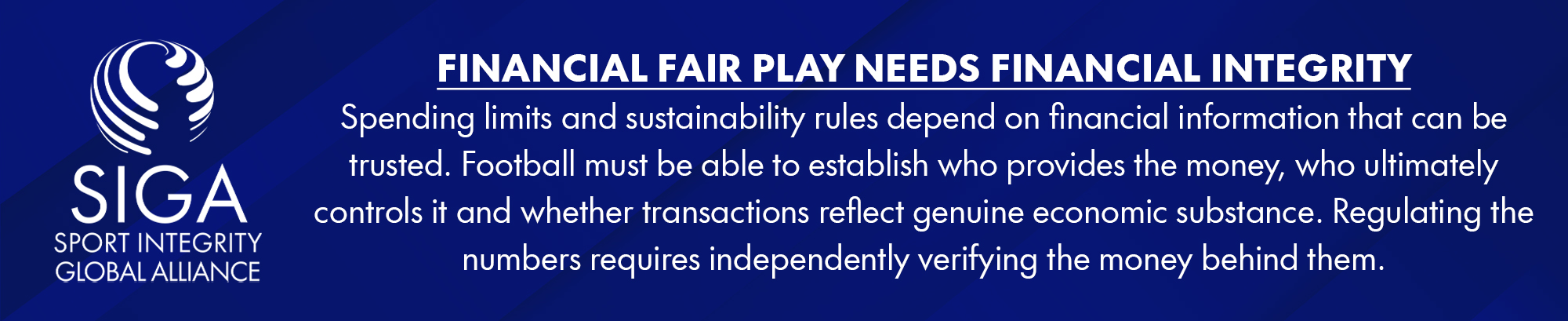 THE QUESTION BEFORE THE NUMBERS
For years, with the necessary and understandable objective of ensuring that clubs “live within their means”, football’s financial regulation has concentrated predominantly on sustainability: how much a club may spend, how losses should be calculated, which revenues may be recognised, and how the financial viability of clubs and competitions should be protected.
All of this remains necessary. But there is a question that comes before it: how certain are we that the financial information on which those rules depend reflects economic reality?
That is where “Financial Fair Play” and “Financial Integrity” part company.
Financial Fair Play asks whether the numbers comply with the rules. Financial Integrity asks whether the numbers themselves can be trusted.
Where did the money come from? Who ultimately provided it? Who controls it? Who benefits? Is the financial transaction genuine? Does the value attributed to it correspond to its economic substance? Are related parties properly identified? Are ownership and control transparent? Can the payment be traced? And can all of this be independently verified?
These are not peripheral questions. I have raised them repeatedly over the years because they go to the credibility of the entire regulatory system.
Disclosure is not verification.
If the underlying financial reality cannot be reliably established, even the most sophisticated expenditure controls rest on incomplete foundations.
That is not a Manchester City problem. It is a structural challenge for football as a whole — and for the global economic ecosystem that now surrounds it.
FOOTBALL’S FRAGMENTED FINANCIAL ARCHITECTURE
Modern football bears little resemblance to the financial environment in which many of its regulatory concepts were first developed.
Football is now a massive global economic ecosystem — and a global business of extraordinary scale. Club acquisitions, equity financing, shareholder loans, private equity, private credit, sponsorship, image rights, transfer receivables, agents and intermediaries, investment vehicles, related-party transactions and multi-jurisdictional corporate structures all form part of that reality.
Billions move through the game. Yet responsibility for understanding and scrutinising those financial flows remains widely dispersed.
National associations and leagues exercise their respective domestic regulatory responsibilities. Confederations impose financial and licensing requirements for participation in their own competitions; that role does not amount to general financial oversight of domestic football.
Auditors examine accounts. Tax authorities exercise separate statutory responsibilities. Financial Intelligence Units address financial-crime risks. Financial supervisors, competition authorities and law-enforcement bodies may each hold different pieces of information under different legal mandates.
The financial relationships may cross borders, while each institution’s authority and access to information remain bounded by its remit.
The challenge is ensuring that the system can see the whole.
That requires cooperation which respects the responsibilities of each institution while addressing the gaps between them.
Football has invested enormous energy in writing financial rules. It has invested considerably less in creating an integrated infrastructure capable of verifying the economic reality behind them.
That imbalance is no longer sustainable.
EUROPE HAS ALREADY MOVED
Public policy is already moving beyond football’s traditional regulatory perimeter.
Under the European Union’s new anti-money-laundering framework, professional football clubs and players’ agents will become obliged entities from 10 July 2029, subject to the framework’s scope and specified risk-based exemptions for certain clubs. The requirements include customer due diligence, beneficial ownership checks, monitoring and the reporting of suspicious activity.
The direction of travel could hardly be clearer.
Europe has recognised that football’s substantial financial flows, cross-border transactions and increasingly complex ownership structures create risks that cannot be treated solely as internal sporting matters.
AMLA, the European Union’s Anti-Money Laundering Authority, has a coordinating role in strengthening supervision and cooperation between Financial Intelligence Units. Its role should not be confused with that of football’s sporting regulators.
Football should read these developments for what they are: a warning — and an opportunity.
The strongest sporting institutions will be those capable of anticipating legitimate public scrutiny, raising their own standards and developing systems that work effectively with public authorities while preserving the legitimate autonomy of sport.
The answer is not indiscriminate regulation. It is better architecture.
 FROM TRANSPARENCY TO VERIFICATION
SIGA has advocated precisely this approach for years.
Our Universal Standards on Financial Integrity in Sport were conceived around three interdependent pillars: integrity and transparency, financial sustainability and fiscal responsibility.
They address risks ranging from ownership and financial reporting to transfers, agents and intermediaries, taxation, money laundering, procurement and commercial contracting.
The principle is straightforward: know who owns. Know who controls. Know who pays. Know where the money comes from. Know where it goes. And verify it independently.
Transparency is indispensable. But transparency cannot mean disclosure for disclosure’s sake. It must be meaningful, comparable and measurable.
That is also the logic behind the SIGA Sport Transparency Index: moving beyond general declarations of openness and examining what sporting organisations actually disclose and how accessible that information is.
Transparency makes information available for scrutiny. Verification establishes whether the evidence supports the claims being made. Both are necessary.
One essential component of the architecture, however, remains missing.
FOLLOW THE MONEY
For the past 25 years, I have advocated the establishment of a global, independent Clearing House for Sport.
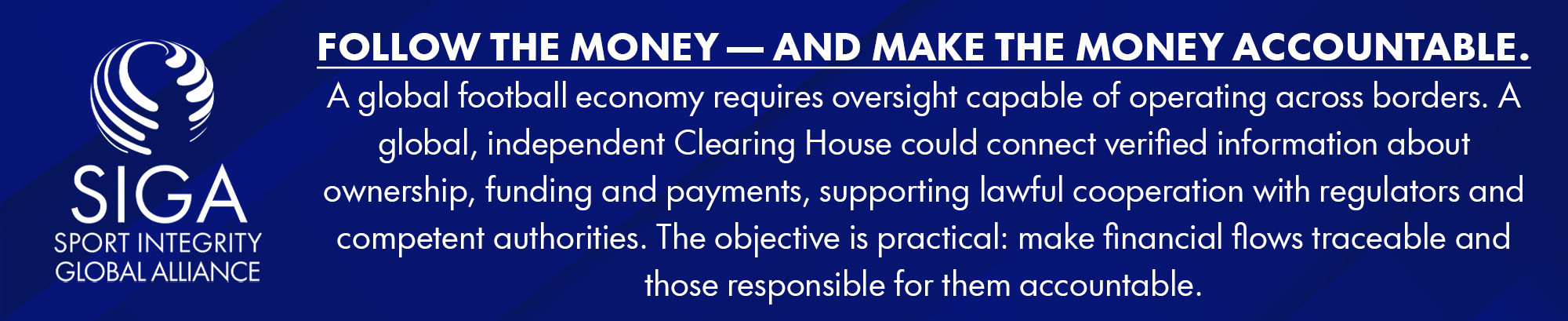
Its fundamental purpose can be expressed simply: follow the money — and make the money accountable.
This proposal must not be confused with the FIFA Clearing House. FIFA’s mechanism processes training compensation and solidarity contributions for clubs involved in developing young players. That is a legitimate but specific function. It does not constitute the comprehensive financial-integrity mechanism I have long advocated.
The distinction is one of purpose and scope.
The global Clearing House I propose would address material financial transactions across the sporting economy. It would be capable, within the boundaries of applicable law, of helping verify transaction parties; identifying relevant ultimate beneficial owners; establishing source of funds; validating contractual relationships; tracing payments; identifying related parties and conflicts of interest; detecting financial-integrity risks; and enabling appropriate cooperation with competent authorities.
SIGA’s Universal Standards on Financial Integrity already envisage a centralised clearing mechanism for financial transactions in sport. The case for developing that concept further is becoming stronger.
In an industry moving billions across borders, establishing who paid whom, through which entity, with whose money and for what consideration should form part of the normal integrity infrastructure.
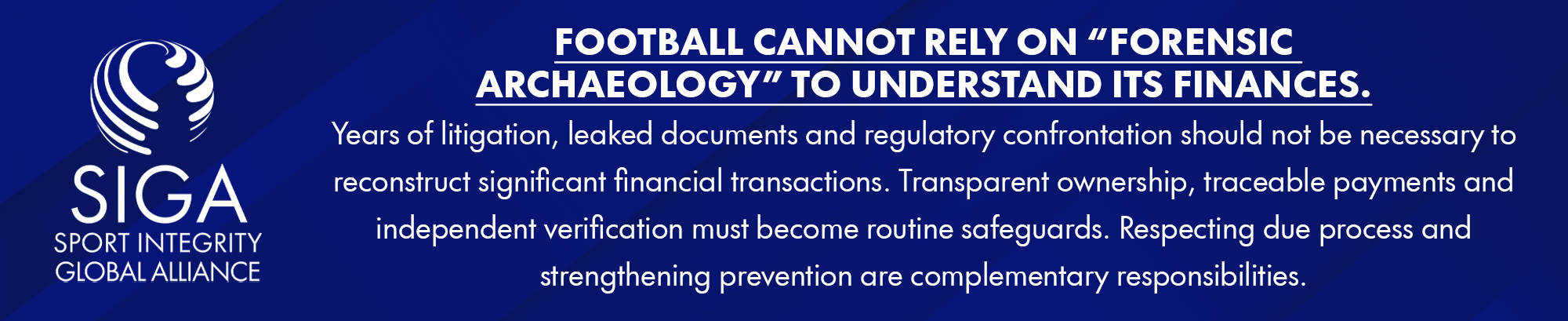
Football should not need years of litigation, leaked documents, regulatory confrontation and forensic reconstruction simply to understand the economic substance of significant financial transactions.
That is not prevention. It is forensic archaeology.
A global Clearing House should not replace football regulators, national supervisors, tax authorities, Financial Intelligence Units or law enforcement. Its role should be complementary: strengthening traceability, verification and lawful information-sharing within an inherently international sporting economy.
Its credibility would require independent governance, clear responsibilities, proportionate requirements and safeguards for data protection and legitimate commercial confidentiality.
The technology and standards provide a foundation. What remains is the collective will to develop them into a workable infrastructure.
FROM COMPLIANCE TO ASSURANCE
There is another change that cannot be postponed.
Sport has spent decades asking organisations to adopt rules, publish policies and declare compliance. That model has reached its limits.
Integrity cannot ultimately depend upon self-description. It must be capable of independent demonstration.
That is precisely the philosophy behind SIRVS — the SIGA Independent Rating & Verification System: rigorous, impartial and independent assessment of sporting organisations against the SIGA Universal Standards.
It represents the necessary transition from compliance to assurance, from declaration to evidence, and from self-assessment to Independent Scrutiny.
The direction should therefore be clear:
Universal Standards. Transparency. Independent Verification. Certification.
These are the foundations of trust. Each has a distinct function, and certification must follow demonstrable implementation rather than substitute for it.
Together, they give substance to the ambition that has driven SIGA from the outset: ALL SPORTS. ALL COUNTRIES. SIGA CERTIFIED.
As a global integrity benchmark, this means that athletes, supporters, sponsors, investors, governments and regulators can have objective assurance that an organisation has not merely claimed to meet recognised standards of integrity.
It has demonstrated that it does.
THE MOMENT TO CHANGE THE SYSTEM
Manchester City’s appeal must now proceed. Its outcome will matter enormously to the club, the Premier League and English football. No responsible observer should anticipate that outcome.
But the wider lesson should not depend on who ultimately succeeds in the proceedings.
Financial Fair Play was an important response to a particular stage in football’s development. The game’s financing, ownership structures and commercial sophistication have since changed profoundly. Its regulatory architecture must now change with it.
The next generation of football regulation must move beyond controlling expenditure and address the integrity of the financial ecosystem itself.
That requires leadership and a commensurate sense of responsibility.
FIFA, the confederations, national associations, leagues, clubs, regulators, governments, investors, sponsors and financial institutions should come together, within their respective responsibilities, to build a coherent global financial-integrity architecture.
Universal Financial Integrity Standards should become the norm. Ownership and material financial flows should be genuinely transparent. A global, independent Clearing House should be established with the capability to follow the money. Independent Scrutiny should become standard practice, with certification providing objective assurance that recognised standards are being met.
The Manchester City case should not be reduced to another cycle of allegation, judgment, appeal and controversy.
Whatever its eventual legal outcome, it offers football an opportunity to recognise that the integrity of the modern game depends not only on the rules governing the numbers, but on our collective ability to understand, trace and independently verify the money behind them.
The case should not merely test football’s rules. It should compel football to build a system worthy of the game — and the global business — it has become.
– THE END –
ABOUT SIGA
SIGA is the world’s leading organisation for Sport Integrity. We are creating a whole new landscape for the sports industry by delivering independent global rating and certification for world Sport to ensure it is governed and operates under the highest integrity standards: The SIGA Universal Standards.
Funded by our Members, SIGA is a non for profit global independent organisation with one aim: To ensure the sport industry is governed under the highest integrity standards so that the values of sport are protected.
SIGA is the only organisation to bring together sport, governments, academia, international organisations, sponsors, business, rights holders, NGOs and professional services companies, from every region in the world, around a common cause of fostering greater integrity throughout sport.
SIGA is headquartered in Geneva, Switzerland, as a non for-profit association, and comprises of the following continental subsidiaries: SIGA AMERICA, SIGA EUROPE and SIGA LATIN AMERICA.
For more information on SIGA, including its vision, mission and reform agenda, please refer to the website: www.siga-sport.com and FAQs.
To contact SIGA, please email: comms@siga-sport.com.
@Sigalliance – Twitter, Instagram, Linkedin | #SIGA #SIGAWoW