

Football knows the risks. The solution exists. What is missing? The courage to act.

By Emanuel Macedo de Medeiros
Co-Founder & Global CEO, SIGA
Football has never attracted more money, investment or global interest. Clubs have become valuable international assets. Investment funds and multi-club ownership structures have expanded across borders. And player transfers generate financial flows of unprecedented scale and complexity.
This brings opportunity, but also responsibility.
Do we really know who owns, finances and ultimately controls the game?
A shareholders’ register cannot provide the full answer. We must know who stands behind the company or fund; who provides its equity and debt; who its creditors, lenders and guarantors are; what economic or control rights they possess; and whether offshore companies, tax havens, trusts, nominees or shell companies are involved. We must identify the ultimate beneficial owners and establish where the money comes from, how it moves and where it ultimately goes.
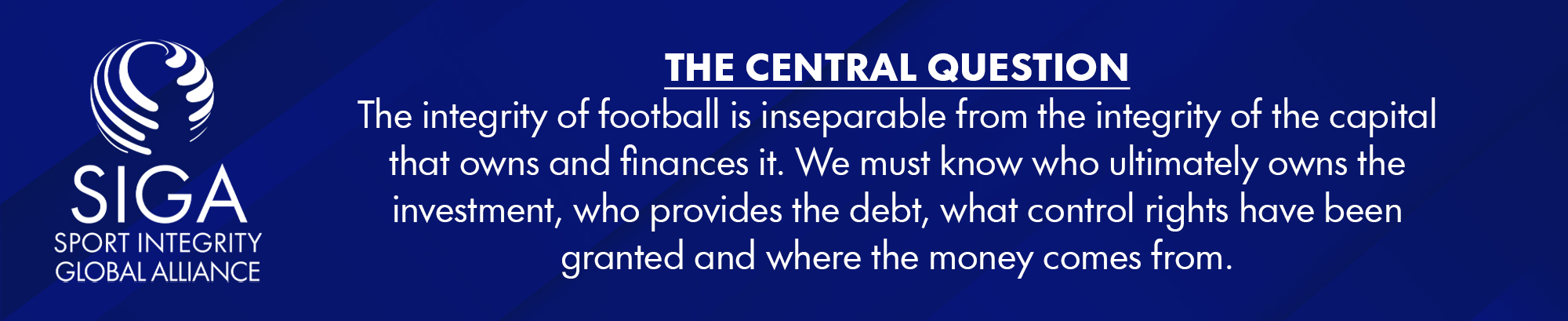
These are not technicalities. Ownership confers power over clubs, players and competitions. The integrity of football is therefore inseparable from the integrity of the capital that owns and finances it.
WE HAVE KNOWN FOR LONG ENOUGH
The warnings could hardly have been clearer. In 2007, when I was CEO of the Association of European Professional Football Leagues, we submitted a position paper to the European Commission addressing the challenges confronting professional football and the measures required to strengthen its credibility and integrity. The Commission subsequently reflected those concerns in its White Paper on Sport, expressly identifying money laundering among the threats facing Sport.
In 2009, the Financial Action Task Force published Money Laundering through the Football Sector. It examined vulnerabilities involving club ownership, player transfers, betting, image rights and sponsorship; referred to tax havens, front companies and politically exposed persons; and found that controls over the origin and destination of payments were often weak or absent. FIFA and UEFA were among the organisations engaged in its preparation.
The risks were therefore neither unknown nor unforeseen. They had been identified, formally documented and brought directly to the attention of the institutions with the authority to act. That was nearly two decades ago.
Since then, some progress has been made. But not enough.
For more than 30 years, in every role I have exercised at club, league and international level — and now as Global CEO of SIGA — I have worked to ensure that football and wider Sport are recognised for their immense social and economic contribution and treated as credible and responsible sectors. I have never accepted the prejudice that regarded Sport as institutionally immature or as some sort of underdog in the eyes of governments, international organisations and certain sectors of public opinion. I know football from the inside and have witnessed and contributed to the profound transformation it has undergone.
When European football faced chronic and persistent indebtedness, I worked alongside UEFA and the professional leagues to confront that reality. The leagues played a decisive role in strengthening club licensing, promoting financial discipline and embedding a culture of financial stability and sustainability. That collective effort led to more robust financial, governance and infrastructure requirements and helped pave the way for Financial Fair Play, drawing upon established precedents such as France’s Direction Nationale du Contrôle de Gestion.
Those reforms proved that football can address structural problems when leadership, regulation and determination come together. That progress makes the continued delay over financial transparency more — not less — difficult to understand.
THE MONEY HAS MOVED. THE SYSTEM HAS NOT.
The latest figures underline the scale of the responsibility. Between 1 June and 2 September 2026, FIFA’s Transfer Matching System recorded 12,575 international transfers in men’s professional football, involving approximately USD 9.89 billion in declared transfer-fee commitments. England alone accounted for more than USD 3 billion in expenditure, while Portugal spent approximately USD 301 million and received USD 642 million.
Women’s football recorded a further 1,406 international transfers and USD 28.6 million in fees — already equivalent to the whole of 2025.
Yet TMS covers only international transfers. An analysis of reported and estimated fees compiled by Transfermarkt indicates almost EUR 3 billion in domestic transfer activity across the leading divisions of England, Italy, Germany, France, Spain and Portugal during the same period. And even these figures do not capture salaries, bonuses, image rights, agents’ commissions, shareholder loans, private credit, transfer-receivable financing or club acquisitions.
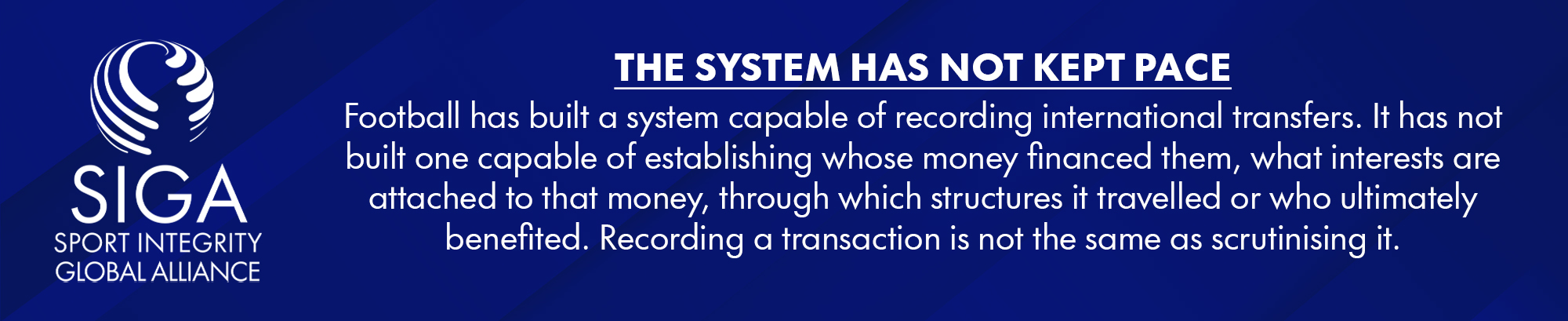
Transfers are not the whole story. They are one window into a wider integrity challenge. Recording a transaction does not establish whose money financed it, what interests are attached to that money, through which structures it travelled or who ultimately benefited. Disclosure is not scrutiny, and an investor’s declaration cannot be treated as independent evidence of integrity.
THE CLEARING HOUSE FOOTBALL SHOULD ALREADY HAVE
More than 25 years ago, I put forward a proposal for a genuine Clearing House capable of safeguarding financial integrity, transparency and accountability across both world football and domestic competitions. I have advocated it ever since, raising it repeatedly with FIFA, UEFA and the leaders of the relevant football institutions.
I have personally discussed this matter with the current FIFA President on more than one occasion. He knows precisely what I think. During one of our regular working meetings, while he was still at UEFA, he told me he had “mixed feelings” about it. I respect his candour and understand the institutional, regulatory and financial complexity involved. But mixed feelings cannot become policy or indefinitely postpone a reform fundamental to football’s credibility.
Let us be clear: what FIFA currently calls its “Clearing House” is a mechanism confined to training compensation and solidarity payments. It is a positive step, but it is neither the Clearing House I proposed nor the one world football needs. It performs a useful but limited administrative function; it does not possess the scope, authority or capabilities required to scrutinise the financial flows of modern football. It is a drop in the ocean. Neither its name nor its prestigious Paris address makes it the comprehensive financial-integrity mechanism the game requires.
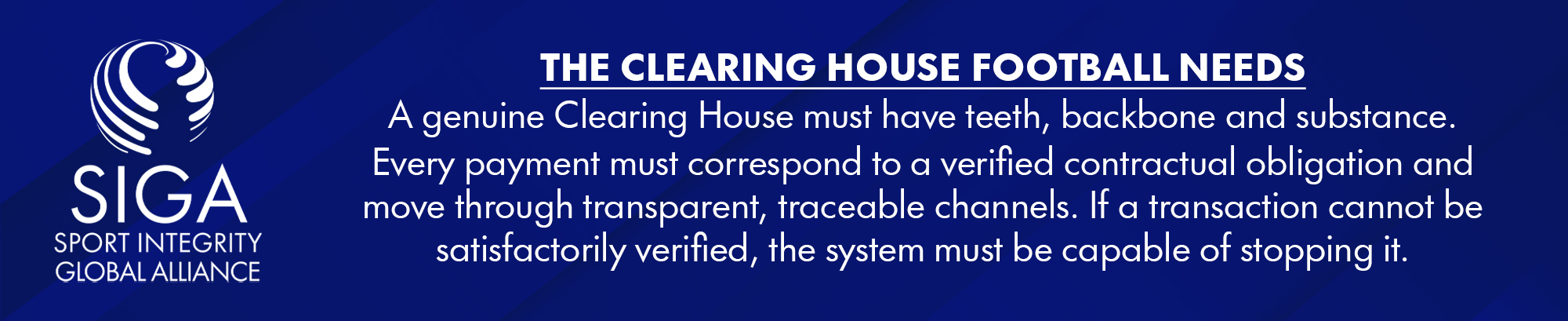
A genuine Clearing House must have teeth, backbone and substance. It must cover domestic and international transfers, instalments, conditional payments and payments to agents and intermediaries, in accordance with the law applicable in each jurisdiction. Every payment must correspond to a verified contractual obligation and move through transparent, traceable channels. The parties and relevant ultimate beneficial owners must be fully identified, the source of funds established, conflicts of interest and financial-crime risks assessed, and suspicious activity referred to the competent authorities.
Its remit must connect transfer flows with scrutiny of club ownership and financing. It must establish who is acquiring the club, who stands behind the company or fund, who provides the capital and debt, what security has been granted, who holds material economic or control rights, and whether the same interests own or influence other clubs. This scrutiny must be continuous, because ownership, financing and control can change after an acquisition has been approved.
This is not an argument against investment. On the contrary, football bodies and responsible investors can only benefit from a system that protects clubs, competitions and legitimate capital from concealed conflicts, criminal infiltration and reputational risk. A genuine Clearing House does not obstruct the market. It makes it more credible. Is that not what we all aspire to?
FIFA regulates the international transfer system, operates TMS and possesses the global reach required to bring together confederations, national associations, leagues, clubs, financial institutions and public authorities. Establishing this mechanism must therefore be one of FIFA’s primary responsibilities.
THE VACUUM FOOTBALL LEFT BEHIND
The European Union has now recognised the urgency and decided to act. Under Regulation (EU) 2024/1624, football agents and professional football clubs will become obliged entities under the EU’s anti-money-laundering framework. For clubs, the relevant transactions include those involving investors, sponsors, agents and other intermediaries, as well as player transfers. These provisions are scheduled to apply from 10 July 2029.
Yet regional regulation cannot, by itself, resolve a global problem. Without coherent rules and effective scrutiny internationally and nationally, financial activity will inevitably gravitate towards the jurisdictions where oversight is weakest.
This is characteristic of the prevailing mentality in football. For years, football’s governing bodies knew what was required. They understood the vulnerabilities, possessed the regulatory authority and had the opportunity to act, but chose not to establish the comprehensive Clearing House the game needed, both internationally and nationally. The vacuum was inexorably left for the European Union to fill.
Some in football may describe this as external interference and an attack on the autonomy of sport, but it is nothing of the sort. When sports governing bodies fail to address known risks, public authorities have both the right and the duty to intervene. External regulation is not the cause of football’s inaction; it is the consequence.
This is why, as I often say, sporting autonomy is neither unlimited nor unconditional. It must be exercised responsibly, supported by accountability and justified by effective action. If football wishes to preserve its autonomy, as I believe it does, it must also demonstrate the will and capacity to govern itself in the public interest. On financial integrity and transparency, it has been given more than enough time to do so.
Nor does football need to reinvent the wheel. The SIGA Universal Standards on Financial Integrity in Sport provide the comprehensive, independent and sport-specific framework required. They address beneficial ownership, source of wealth and source of funds, anti-money-laundering controls, club ownership, related-party transactions, intermediaries, traceable payments and responsible investment. SIGA’s Gap Analysis and SIRVS provide the means to assess implementation through independent scrutiny and certification.
The risks have been identified. The regulatory direction is clear. The standards have been written. The technology exists. It is all there.
So, do me a favour: until a genuine Clearing House is established, do not expect me to believe that the relevant authorities — including sports governing bodies — are doing everything within their power to safeguard the financial integrity and transparency of football. No sport can demand trust while failing to establish who owns and finances its clubs. It cannot celebrate record transfer markets while declining to follow the money from its origin to its final destination. And it cannot proclaim transparency and accountability while postponing the mechanism capable of making both real.
History will not judge football’s leaders by the reports they commissioned, the assurances they offered or the sincerity of their mixed feelings. It will judge them by whether, when the risks were known and the solution was available, they had the courage to act.
– THE END –
ABOUT SIGA
SIGA is the world’s leading organisation for Sport Integrity. We are creating a whole new landscape for the sports industry by delivering independent global rating and certification for world Sport to ensure it is governed and operates under the highest integrity standards: The SIGA Universal Standards.
Funded by our Members, SIGA is a non for profit global independent organisation with one aim: To ensure the sport industry is governed under the highest integrity standards so that the values of sport are protected.
SIGA is the only organisation to bring together sport, governments, academia, international organisations, sponsors, business, rights holders, NGOs and professional services companies, from every region in the world, around a common cause of fostering greater integrity throughout sport.
SIGA is headquartered in Geneva, Switzerland, as a non for-profit association, and comprises of the following continental subsidiaries: SIGA AMERICA, SIGA EUROPE and SIGA LATIN AMERICA.
For more information on SIGA, including its vision, mission and reform agenda, please refer to the website: www.siga-sport.com and FAQs.
To contact SIGA, please email: comms@siga-sport.com.
@Sigalliance – Twitter, Instagram, Linkedin | #SIGA #SIGAWoW