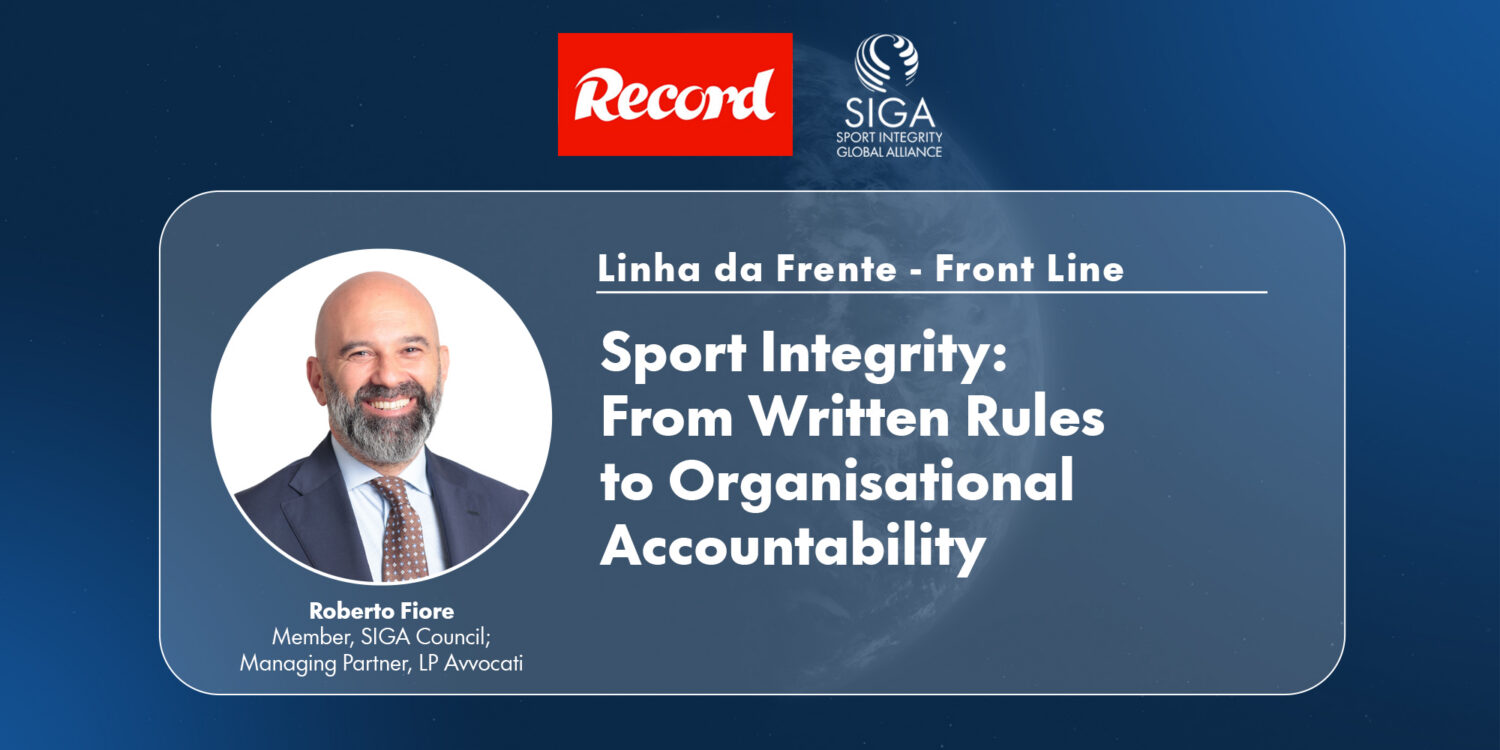
Launched on 4 June 2026 in Record, Portugal’s leading sports newspaper, SIGA’s weekly opinion column Linha da Frente (Front Line, in Portuguese) provides a dedicated platform to address issues at the heart of SIGA’s global agenda, including Sport Integrity, good governance, transparency, accountability, financial integrity, sports betting integrity, sustainability, youth development and protection, and the future of sport.
Click to read this week’s article in Portuguese.
Sport Integrity: From Written Rules to Organisational Accountability
By Roberto Fiore
Member, SIGA Council; Managing Partner, LP Avvocati
Integrity is the foundation of sport’s credibility and of the trust that athletes, fans, sponsors and institutions place in competition. In recent years the sector has adopted codes of ethics, regulations and oversight bodies. A fundamental challenge nonetheless remains: ensuring that these instruments translate into effective and verifiable practice within organisations.
The Italian experience offers a useful reference point. Legislative Decree No. 231/2001 introduced the administrative liability of legal entities for certain offences committed in their interest or to their advantage, while recognising that the adoption and effective implementation of an organisation, management and control model may exempt them from liability. Over more than twenty years of application, a clear principle has emerged: a model is adequate only if it rests on a genuine risk assessment, a coherent system of delegated powers and procedures, sound oversight of financial flows and supervision by a body endowed with autonomy and independence.
This principle is particularly relevant to professional sport, now an economic sector of primary importance. Player transfers, intermediary fees, broadcasting rights, sponsorships and relationships with betting operators involve significant financial flows and, consequently, specific risk profiles. Corruption, money laundering, conflicts of interest and competition manipulation take hold wherever decision-making processes lack transparency and controls are insufficient.
Sport integrity must therefore be addressed not only as a matter of individual ethics, but as a question of governance and organisational structure. Clubs, leagues and federations have a responsibility to put in place structured systems that prevent misconduct and help bring it to light: mapping of sensitive processes, segregation of duties, counterparty due diligence, traceability of decisions and reporting channels that guarantee whistleblower protection.
A further element is decisive: independent verification. Self-assessment cannot offer stakeholders the assurance provided by external scrutiny. In this respect, the Universal Standards developed by SIGA and the SIGA Independent Rating and Verification System (SIRVS) provide a common and measurable benchmark for good governance, financial integrity and betting integrity. The certification obtained by Liga Portugal is a significant signal, and we hope it will be followed by other leagues and federations across Europe.
Likewise, the standards required of listed companies or of businesses contracting with public authorities should apply to organisations that manage substantial resources and, above all, a heritage of collective trust. Fans, sponsors and commercial partners are fully fledged stakeholders with legitimate interests and are entitled to an appropriate level of transparency.
Compliance, however, must not become a mere formality. An effective control system must be proportionate to the size of the organisation and to its actual risk profile. An amateur club and a professional league have different needs, but both require clear rules on decision-making powers, the management of resources and accountability.
Sport demands loyalty and respect for the rules from its protagonists. It is only consistent to expect the same commitment from the institutions that govern it, through clear rules, effective controls and genuinely independent oversight bodies. Integrity cannot simply be declared: it must be organised, measured and demonstrated over time.
– THE END –
Previous Front Line articles
- Front Line Op-Ed: Sport Integrity – The Value of Trust (4 June 2026, Emanuel Macedo de Medeiros)
- Front Line Op-Ed: The Fight Against Corruption in Sport Is Far From Over — And We Cannot Afford to Look Away (10 June 2026, Richard Weber)
- Front Line Op-Ed: Trust: Football’s Silent Capital (11 June 2026, Emanuel Macedo de Medeiros)
- Front Line Op-Ed: The Trust Test (18 June 2026, Emanuel Macedo de Medeiros)
- Front Line Op-Ed: Fashion Has Joined Forces with Sport. Now It Needs to Help Make It Better (25 June 2026, Emanuel Macedo de Medeiros)
- Front Line Op-Ed: Integrity in Youth Football: Protecting the Future On and Off the Pitch (2 July 2026, Miguel Gouveia de Brito)
- Front Line Op-Ed: Digital Success, IP Protection and Sports Integrity (9 July 2026, Martin Bland)
- Front Line Op-Ed: Prevention Rather Than Cure: What the World Cup Leaves Behind on Preventing Integrity Issues (16 July, Paul Buck)
- Front Line Op-Ed: Separating the Wheat from the Chaff — and the Courage to Decide (23 July, João Paulo Almeida)
- Front Line Op-Ed: After the Greatest World Cup Ever, FIFA Faces Its Greatest Test (30 July, Emanuel Macedo de Medeiros)
- Front Line Op-Ed: Mentoring Beyond Careers: Shaping the Future of Sport (6 August, Laura Cordingley)
- Front Line Op-Ed: FIFA’s Democracy Needs a Firewall Between Money and Votes (13 August, Mohammed Hanzab)
- Front Line Op-Ed: Can the World Cup Be Privately Managed? (20 August, Fernando Veiga Gomes)
- Front Line Op-Ed: What If Governing Well Isn’t That Complicated? (27 August, Nuno Perestrelo)
- Front Line Op-Ed: The Liquidity Sport Lacks — and the Scrutiny Its Money Demands (27 August, João Paulo Almeida)
- Front Line Op-Ed: Why Sport Clubs Need to Work Together (10 August, Iain Lindsay)
- Front Line Op-Ed: The Human Rights Game – An Example from Argentina (17 September, Pablo Perel)
- Front Line Op-Ed: ‘Bets’, the Vulnerable, and the Temptation of Easy Politics (1 October, João Paulo Almeida)
- Front Line Op-Ed: From Vision to Action: A Month for Sport Integrity (8 October, Nuno Perestrelo)
- Front Line Op-Ed: Sport Integrity in Latin America: From Individual Effort to Institutional Commitment (15 October, Vinicius Sousa)
- Front Line Op-Ed: Sports Leaders, Gratitude and the Accountability We Still Lack (22 October, João Paulo Almeida)
ABOUT SIGA
SIGA is the world’s leading organisation for Sport Integrity. We are creating a whole new landscape for the sports industry by delivering independent global rating and certification for world Sport to ensure it is governed and operates under the highest integrity standards: The SIGA Universal Standards.
Funded by our Members, SIGA is a non for profit global independent organisation with one aim: To ensure the sport industry is governed under the highest integrity standards so that the values of sport are protected.
SIGA is the only organisation to bring together sport, governments, academia, international organisations, sponsors, business, rights holders, NGOs and professional services companies, from every region in the world, around a common cause of fostering greater integrity throughout sport.
SIGA is headquartered in Geneva, Switzerland, as a non for-profit association, and comprises of the following continental subsidiaries: SIGA AMERICA, SIGA ASIA, SIGA EUROPE and SIGA LATIN AMERICA.
For more information on SIGA, including its vision, mission and reform agenda, please refer to the website: www.siga-sport.com and FAQs.
To contact SIGA, please email: comms@siga-sport.com.