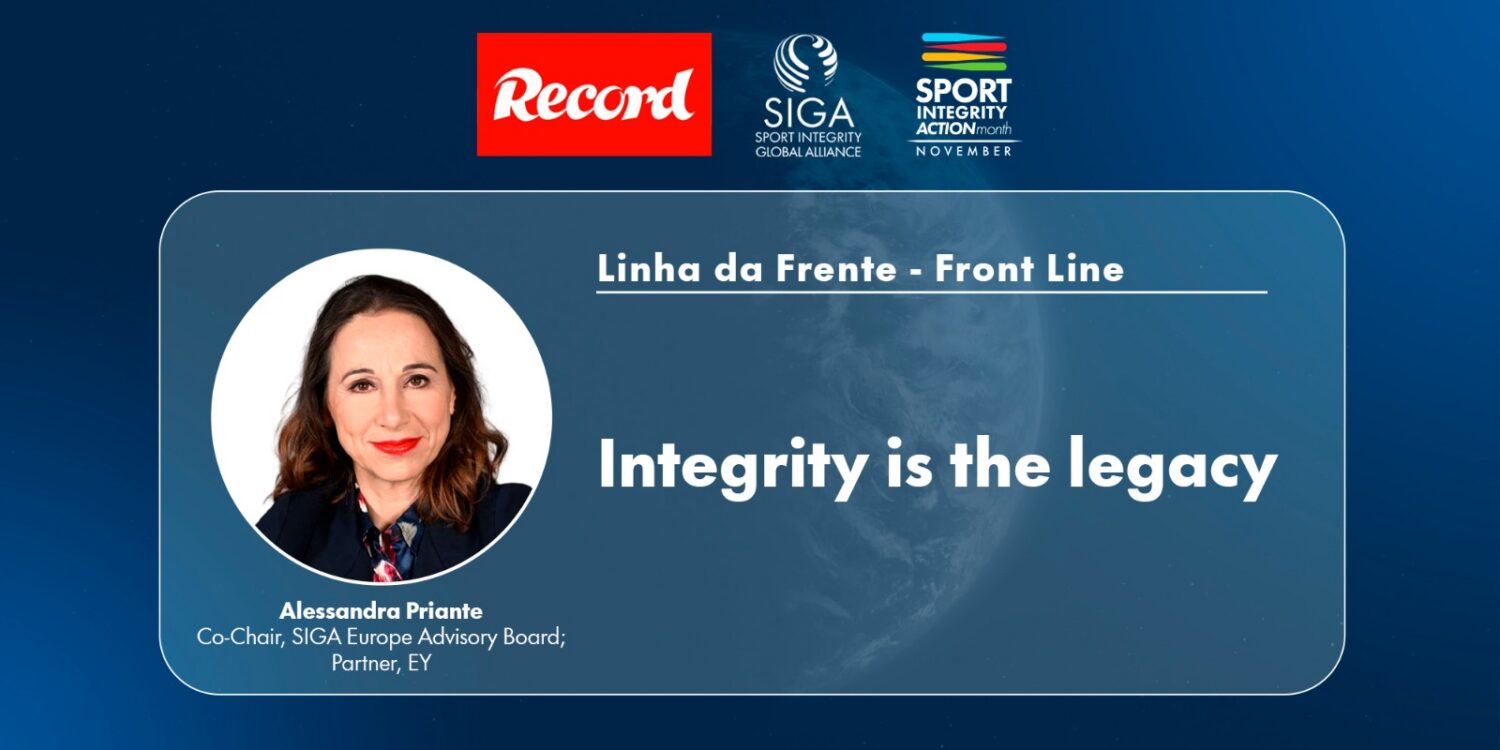
Launched on 4 June 2026 in Record, Portugal’s leading sports newspaper, SIGA’s weekly opinion column Linha da Frente (Front Line, in Portuguese) provides a dedicated platform to address issues at the heart of SIGA’s global agenda, including Sport Integrity, good governance, transparency, accountability, financial integrity, sports betting integrity, sustainability, youth development and protection, and the future of sport.
Click to read this week’s article in Portuguese.
Integrity is the legacy
Alessandra Priante
Co-Chair, SIGA Europe Advisory Board; Partner, EY
In 2030, the FIFA World Cup will be played across three countries and two continents. Portugal, Spain and Morocco will host it, with the opening celebrations of the tournament’s centenary in Uruguay, Argentina and Paraguay. It will be the most complex event football has ever organised, and for the host countries one of the largest public investment programmes of the decade: stadiums, transport, security, digital infrastructure, hospitality.
I have spent most of my career on the other side of events like this one. As Director for Europe at UN Tourism, and later at the head of Italy’s national tourism board, I saw cities bid, win, build, celebrate and then live with the consequences. Some came out stronger, with new skills, better connections and a reputation that kept attracting visitors and investors for decades. Others were left with empty venues, contested contracts and citizens who still associate the word “event” with waste.
What separated the two outcomes, again and again, was the quality of the governance.
This is where sport integrity meets the economy of places. When we talk about integrity in sport, we think first of match-fixing, doping, illegal betting, abuse of power inside federations. All of that matters enormously. But a mega-event extends the perimeter of integrity far beyond the pitch. It touches public procurement, land use, labour conditions, the rights of residents, the way ticketing and hospitality are managed, the flows of money between sponsors, organisers and intermediaries. Every one of these areas can either build trust or erode it, and trust, once lost, follows a country for a long time.
Three lessons seem to me relevant well beyond the Iberian Peninsula and North Africa.
The first is that integrity has to be designed in, from the bid onwards. Promises made to win hosting rights become obligations towards citizens. Transparent criteria, published budgets, clear conflict-of-interest rules and independent oversight cost very little at the start and a great deal when they are missing. The time to put these safeguards in place is before the first contract is signed.
The second is that verification matters more than declarations. Codes of ethics are easy to write. What builds credibility is the willingness to be assessed against shared standards by someone independent. This is the logic behind SIGA’s Universal Standards and its Independent Rating and Verification System (SIRVS): integrity becomes measurable, comparable and therefore improvable. Professional services firms, my own included, have a natural role here, bringing to sport the same discipline of assurance, risk management and transparency that markets already expect from companies.
The third lesson is that legacy is an integrity question. We usually measure the success of an event by tickets sold, television audiences and visitors in the host cities during the tournament. Those numbers matter, but they say little about what remains. A legacy worthy of the name means infrastructure that stays useful, public money accounted for, local businesses and communities that benefit, young people who play more sport, and a host country whose reputation is stronger after the final whistle than before the opening match. If we want different results, we have to measure different things: what is left behind, and for whom.
Portugal knows the power of sport to shape how a country is seen in the world. Euro 2004 is still remembered as a moment of national pride. With 2030 approaching, it has the opportunity to show, together with Spain and Morocco, that a World Cup can become a reference for integrity as well as for football: open in its decisions, rigorous in its accounts, generous in its legacy.
The responsibility is shared. Governing bodies, governments, host cities, sponsors, broadcasters, betting operators and advisers each hold a piece of the trust that makes sport valuable. None of them can protect it alone. That is precisely why an alliance like SIGA exists: to bring all of these actors around the same table, under the same standards.
Trust is the most valuable asset sport has. Mega-events either multiply it or spend it. The choice is made long before kick-off.
– THE END –
Previous Front Line articles
- Front Line Op-Ed: Sport Integrity – The Value of Trust (4 June 2026, Emanuel Macedo de Medeiros)
- Front Line Op-Ed: The Fight Against Corruption in Sport Is Far From Over — And We Cannot Afford to Look Away (10 June 2026, Richard Weber)
- Front Line Op-Ed: Trust: Football’s Silent Capital (11 June 2026, Emanuel Macedo de Medeiros)
- Front Line Op-Ed: The Trust Test (18 June 2026, Emanuel Macedo de Medeiros)
- Front Line Op-Ed: Fashion Has Joined Forces with Sport. Now It Needs to Help Make It Better (25 June 2026, Emanuel Macedo de Medeiros)
- Front Line Op-Ed: Integrity in Youth Football: Protecting the Future On and Off the Pitch (2 July 2026, Miguel Gouveia de Brito)
- Front Line Op-Ed: Digital Success, IP Protection and Sports Integrity (9 July 2026, Martin Bland)
- Front Line Op-Ed: Prevention Rather Than Cure: What the World Cup Leaves Behind on Preventing Integrity Issues (16 July, Paul Buck)
- Front Line Op-Ed: Separating the Wheat from the Chaff — and the Courage to Decide (23 July, João Paulo Almeida)
- Front Line Op-Ed: After the Greatest World Cup Ever, FIFA Faces Its Greatest Test (30 July, Emanuel Macedo de Medeiros)
- Front Line Op-Ed: Mentoring Beyond Careers: Shaping the Future of Sport (6 August, Laura Cordingley)
- Front Line Op-Ed: FIFA’s Democracy Needs a Firewall Between Money and Votes (13 August, Mohammed Hanzab)
- Front Line Op-Ed: Can the World Cup Be Privately Managed? (20 August, Fernando Veiga Gomes)
- Front Line Op-Ed: What If Governing Well Isn’t That Complicated? (27 August, Nuno Perestrelo)
- Front Line Op-Ed: The Liquidity Sport Lacks — and the Scrutiny Its Money Demands (27 August, João Paulo Almeida)
- Front Line Op-Ed: Why Sport Clubs Need to Work Together (10 August, Iain Lindsay)
- Front Line Op-Ed: The Human Rights Game – An Example from Argentina (17 September, Pablo Perel)
- Front Line Op-Ed: ‘Bets’, the Vulnerable, and the Temptation of Easy Politics (1 October, João Paulo Almeida)
- Front Line Op-Ed: From Vision to Action: A Month for Sport Integrity (8 October, Nuno Perestrelo)
- Front Line Op-Ed: Sport Integrity in Latin America: From Individual Effort to Institutional Commitment (15 October, Vinicius Sousa)
- Front Line Op-Ed: Sports Leaders, Gratitude and the Accountability We Still Lack (22 October, João Paulo Almeida)
- Front Line Op-Ed: Sport Integrity – From Written Rules to Organisational Accountability (29 October, Roberto Fiore)
ABOUT SIGA
SIGA is the world’s leading organisation for Sport Integrity. We are creating a whole new landscape for the sports industry by delivering independent global rating and certification for world Sport to ensure it is governed and operates under the highest integrity standards: The SIGA Universal Standards.
Funded by our Members, SIGA is a non for profit global independent organisation with one aim: To ensure the sport industry is governed under the highest integrity standards so that the values of sport are protected.
SIGA is the only organisation to bring together sport, governments, academia, international organisations, sponsors, business, rights holders, NGOs and professional services companies, from every region in the world, around a common cause of fostering greater integrity throughout sport.
SIGA is headquartered in Geneva, Switzerland, as a non for-profit association, and comprises of the following continental subsidiaries: SIGA AMERICA, SIGA ASIA, SIGA EUROPE and SIGA LATIN AMERICA.
For more information on SIGA, including its vision, mission and reform agenda, please refer to the website: www.siga-sport.com and FAQs.
To contact SIGA, please email: comms@siga-sport.com.