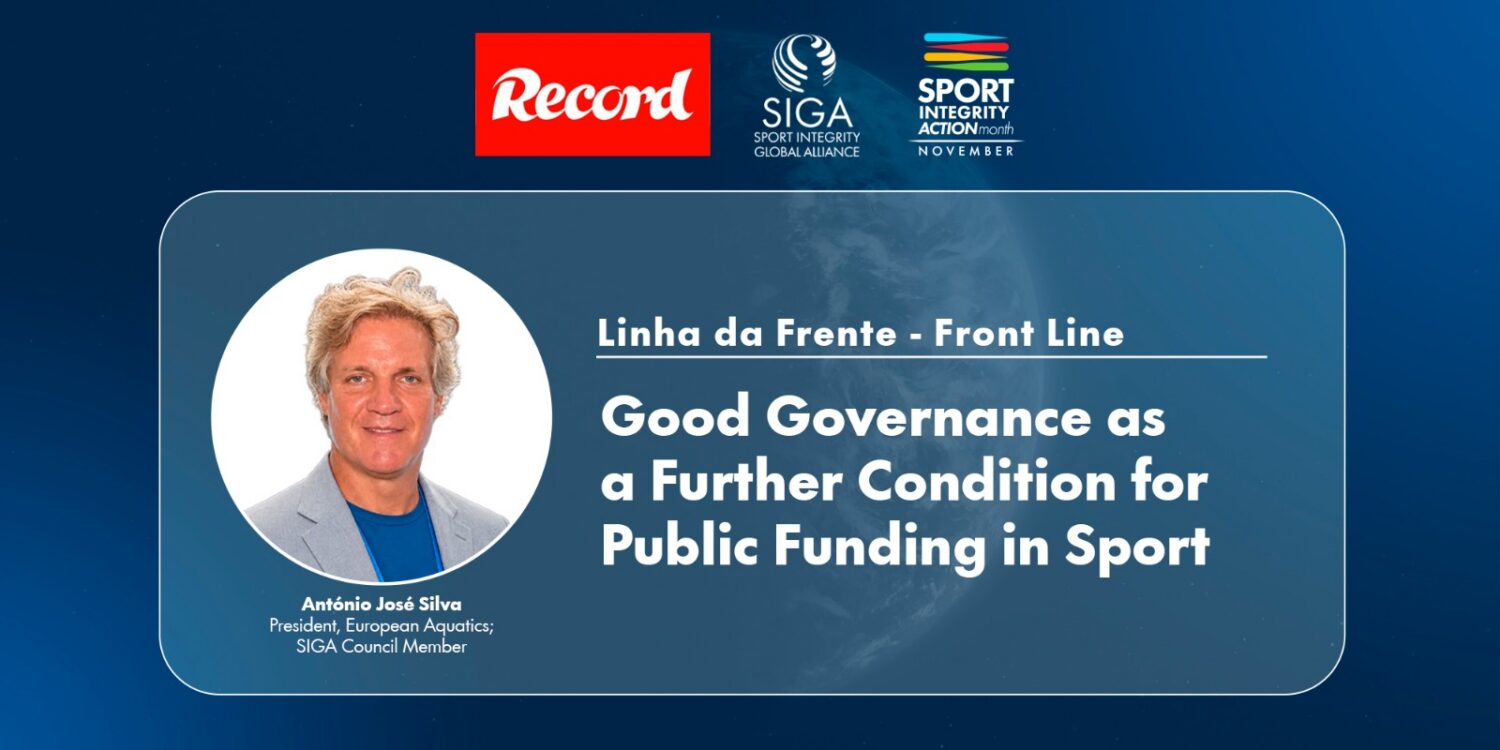
Launched on 4 June 2026 in Record, Portugal’s leading sports newspaper, SIGA’s weekly opinion column Linha da Frente (Front Line, in Portuguese) provides a dedicated platform to address issues at the heart of SIGA’s global agenda, including Sport Integrity, good governance, transparency, accountability, financial integrity, sports betting integrity, sustainability, youth development and protection, and the future of sport.
Click to read this week’s article in Portuguese.
Good Governance as a Further Condition for Public Funding in Sport
António José Silva
President, European Aquatics; SIGA Council Member
On 17 November, the European Commission presented twelve initiatives to strengthen the European Sport Model. Its commitment to responsible autonomy, solidarity and the social role of sport brings renewed relevance to a question we have been raising in Portugal: what assurances of good governance and financial integrity should we require from sports organisations receiving public funding?
We advocate a review of Portugal’s Legal Framework for Sports Federations (RJFD) with this concern in mind. This discussion should extend to the structure of the sporting system itself. What kind of sports organisations and federations do we need? What responsibilities should we entrust to them, and what outcomes should we expect them to deliver?
Freedom of association, recognition of public sporting interest status and access to public funding are three distinct matters. It is in relation to the latter that we propose introducing an objective and verifiable condition. Sports organisations receiving public funds under funding agreements should first obtain independent certification of good governance and integrity.
The funding authority should verify certification before releasing the first payment and ensure that it remains valid throughout the duration of the agreement. Certification could be obtained through the Sport Integrity Global Alliance’s (SIGA) Independent Rating and Verification System (SIRVS) or an equivalent system. The relevant public authorities should define and publish the equivalence criteria, including the independence of assessors, minimum requirements and the frequency of verification.
How do we translate principles into practice? The Sport T-Index, developed through a European project involving SIGA, enables comparisons of organisational transparency based on publicly available information. A Gap Analysis identifies where existing practices fall short of integrity standards and provides the basis for an improvement plan, with clearly assigned responsibilities and deadlines. SIRVS, SIGA’s Independent Rating and Verification System, uses an evidence-based approach to assess the effective implementation of those standards.
What, then, should be verified?
- Whether financial accounts and the criteria for allocating funding are publicly available.
- Whether conflicts of interest are disclosed and appropriately managed.
- Whether athletes are involved in decisions that affect them and have access to effective reporting and safeguarding mechanisms.
A conflict-of-interest rule is only effective if, when an official has a personal interest in a decision, they disclose that interest, recuse themselves from the decision-making process and ensure that their recusal is formally recorded. It is this practical application of the rules that independent assessment must be able to demonstrate.
Requirements should be proportionate to the size of the organisation, the risks associated with its activities and the volume of funds it manages. A volunteer-led association should be able to meet essential requirements through straightforward procedures and shared technical support. Organisations managing substantial sums should be required to demonstrate more robust controls.
A transitional period should allow for initial assessments, training and the remediation of identified shortcomings before the requirement takes effect. Thereafter, the expiry or withdrawal of certification should trigger the suspension of further payments until compliance is restored, in accordance with rules established in advance.
Certification should form part of a multi-year funding framework, with publicly available allocation criteria and objectives tailored to each organisation’s mission.
What proportion of the revenue generated at the highest levels of sport reaches grassroots clubs, youth development programmes and areas where sporting opportunities are more limited?
How many of those who take up a sport are still participating two seasons later?
The European proposal to establish national data hubs for sport and physical activity reinforces the case for a dedicated observatory in Portugal to help answer these questions and assess the outcomes of investment.
Sports organisations must be free to make their own decisions and be accountable for them. Public authorities, in turn, must clearly articulate what they fund, why they fund it and what outcomes are achieved. Requiring independent certification before funding is released makes it possible to enforce that accountability from the very first payment, while there is still an opportunity to improve practices and safeguard the trust of those who participate in, govern and fund sport.
– THE END –
Previous Front Line articles
- Front Line Op-Ed: Sport Integrity – The Value of Trust (4 June 2026, Emanuel Macedo de Medeiros)
- Front Line Op-Ed: The Fight Against Corruption in Sport Is Far From Over — And We Cannot Afford to Look Away (10 June 2026, Richard Weber)
- Front Line Op-Ed: Trust: Football’s Silent Capital (11 June 2026, Emanuel Macedo de Medeiros)
- Front Line Op-Ed: The Trust Test (18 June 2026, Emanuel Macedo de Medeiros)
- Front Line Op-Ed: Fashion Has Joined Forces with Sport. Now It Needs to Help Make It Better (25 June 2026, Emanuel Macedo de Medeiros)
- Front Line Op-Ed: Integrity in Youth Football: Protecting the Future On and Off the Pitch (2 July 2026, Miguel Gouveia de Brito)
- Front Line Op-Ed: Digital Success, IP Protection and Sports Integrity (9 July 2026, Martin Bland)
- Front Line Op-Ed: Prevention Rather Than Cure: What the World Cup Leaves Behind on Preventing Integrity Issues (16 July, Paul Buck)
- Front Line Op-Ed: Separating the Wheat from the Chaff — and the Courage to Decide (23 July, João Paulo Almeida)
- Front Line Op-Ed: After the Greatest World Cup Ever, FIFA Faces Its Greatest Test (30 July, Emanuel Macedo de Medeiros)
- Front Line Op-Ed: Mentoring Beyond Careers: Shaping the Future of Sport (6 August, Laura Cordingley)
- Front Line Op-Ed: FIFA’s Democracy Needs a Firewall Between Money and Votes (13 August, Mohammed Hanzab)
- Front Line Op-Ed: Can the World Cup Be Privately Managed? (20 August, Fernando Veiga Gomes)
- Front Line Op-Ed: What If Governing Well Isn’t That Complicated? (27 August, Nuno Perestrelo)
- Front Line Op-Ed: The Liquidity Sport Lacks — and the Scrutiny Its Money Demands (27 August, João Paulo Almeida)
- Front Line Op-Ed: Why Sport Clubs Need to Work Together (10 August, Iain Lindsay)
- Front Line Op-Ed: The Human Rights Game – An Example from Argentina (17 September, Pablo Perel)
- Front Line Op-Ed: ‘Bets’, the Vulnerable, and the Temptation of Easy Politics (1 October, João Paulo Almeida)
- Front Line Op-Ed: From Vision to Action: A Month for Sport Integrity (8 October, Nuno Perestrelo)
- Front Line Op-Ed: Sport Integrity in Latin America: From Individual Effort to Institutional Commitment (15 October, Vinicius Sousa)
- Front Line Op-Ed: Sports Leaders, Gratitude and the Accountability We Still Lack (22 October, João Paulo Almeida)
- Front Line Op-Ed: Sport Integrity – From Written Rules to Organisational Accountability (29 October, Roberto Fiore)
- Front Line Op-Ed: Integrity is the legacy (5 November, Alessandra Priante)
- Front Line Op-Ed: The Decade of Integrity (12 November, Fernando Veiga Gomes)
- Front Line Op-Ed: Sport Integrity – Sport Integrity – From Paper to Practice (19 November, José Ricardo Gonçalves)
ABOUT SIGA
SIGA is the world’s leading organisation for Sport Integrity. We are creating a whole new landscape for the sports industry by delivering independent global rating and certification for world Sport to ensure it is governed and operates under the highest integrity standards: The SIGA Universal Standards.
Funded by our Members, SIGA is a non for profit global independent organisation with one aim: To ensure the sport industry is governed under the highest integrity standards so that the values of sport are protected.
SIGA is the only organisation to bring together sport, governments, academia, international organisations, sponsors, business, rights holders, NGOs and professional services companies, from every region in the world, around a common cause of fostering greater integrity throughout sport.
SIGA is headquartered in Geneva, Switzerland, as a non for-profit association, and comprises of the following continental subsidiaries: SIGA AMERICA, SIGA ASIA, SIGA EUROPE and SIGA LATIN AMERICA.
For more information on SIGA, including its vision, mission and reform agenda, please refer to the website: www.siga-sport.com and FAQs.
To contact SIGA, please email: comms@siga-sport.com.